
1920s
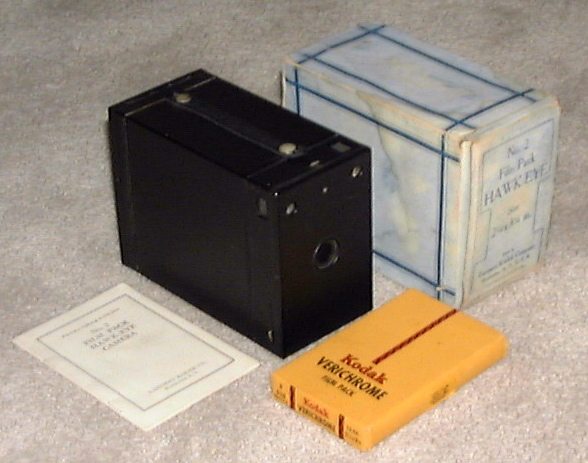
KODAK No. 2 Hawk-Eye FILM PACK CAMERA - 1922.
Produced between 1922 and 1925. It is an all-metal box camera that
takes size 520 pack film as opposed to rollfilm, has a rotary shutter
and a meniscus lens (optical lenses that produce a smaller focal point
and fewer aberrations than a standard plano-convex lens). The
original Hawk-eye camera series was made
by the Boston Camera Company, which was then bought by the Blair Camera
Co., who also produced a line of Hawk-eye Detective cameras in the last
decades of the 19th century. In 1898, Eastman Kodak bought the Blair
Camera Co., moved it to Rochester, and also introduced some cameras
with the Hawk-eye name. MSRP $2.
Film Pack. Introduced by Kodak in 1903 and was at
first called the Premo Film Pack. It was used in the Film
Premo camera and was made in quarter-plate, Postcard and 4 x 5-inch sizes.
Later made in 2 1/4 x 3 1/4 and 5 x 7 inch. The pack contained 12 sheets of film,
thinner than single sheet film, each with a numbered paper tab
attached; it could be inserted into the holder in daylight. The tabs
protruded from the loaded holder; as a sheet was exposed you pulled its
tab which moved the exposed film to the back of the pack.
The film pack goes with the black paper side facing the lens, and the
paper tabs facing away from the hinge. Then close the back on the pack.
Pull the first tab, and tear it off against the pack. That will remove
the paper "dark slide" protecting the first sheet of film.
Expose, pull, tear, repeat. There's no film to expose after pulling the
last tab. Pulling a paper tab loaded a fresh film into place for
each exposure, the previously exposed film being at the same time moved
to the back of the pack. The film was about ASA 50 when new
http://camera-wiki.org/wiki/Kodak_No._2_Film_Pack_Hawk-Eye
 1923
- VLADIMIR ZWORYKIN AND TELEVISION.
Vladimir Zworykin patented the television picture tube in 1923. He
also developed a cathode-ray tube receiver and built console
television
cabinets to house his test mechanisms. In 1924,
Zworykin
filed a patent application for his kinescope that later was to be
called
a television receiver, or just TV.
In 1929, Zworykin
broadcast
the first electronic image through the air from the KDKA radio
transmitter
at the Westinghouse Recreation Center on Greensburg Pike, Pittsburgh,
PA.
The images Zworykin sent were received on a cabinet television at his
home
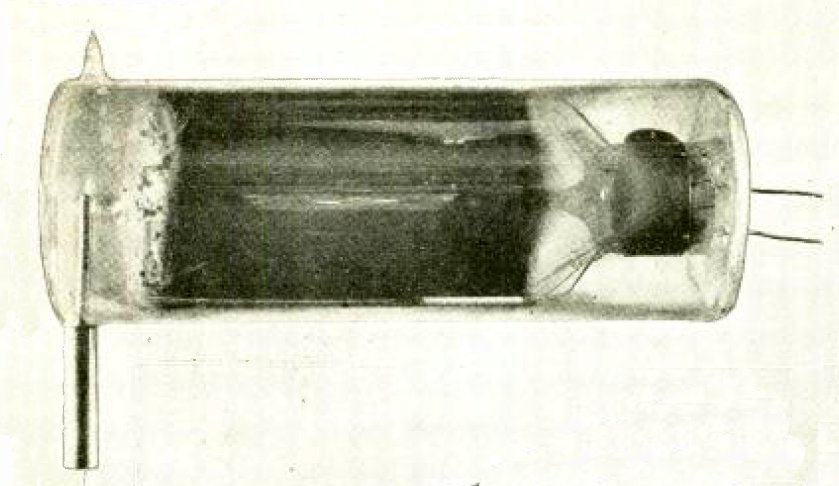
in Swissvale, PA. Zworykin called his picture tube the
"Iconoscope."
This round tube contained the first photoelectric mosaic made from
metal
particles applied to both sides of a sheet of mica. The Iconoscope
allowed
pictures to be electronically broken down into hundreds of thousands of
elements (picture elements, or pixels). The electron beam
received
a photoelectric charge from the mosaic. Zworykin presented the
Iconoscope
at New York in 1929 for an engineer's meeting. Zworykin had been
hired by David Sarnoff of RCA and given the task of developing a TV
equal to that of Philo Farnsworth who had been declared the inventor of
TV by the U.S. Supreme Court. Zworykin was never able to design a
marketable TV without using patents by Philo Farnsworth, but just as
Sarnoff decided to pay Farnsworth for use of his patents, the U.S.
entered World War II and work on television was discontinued for six
years, by which time Farnswoth's patents had run out and RCA was able
to then mass produce TV sets without payment to Farnsworth, the man
responsible for one of the most profitable inventions of all
time.
1923
- VLADIMIR ZWORYKIN AND TELEVISION.
Vladimir Zworykin patented the television picture tube in 1923. He
also developed a cathode-ray tube receiver and built console
television
cabinets to house his test mechanisms. In 1924,
Zworykin
filed a patent application for his kinescope that later was to be
called
a television receiver, or just TV.
In 1929, Zworykin
broadcast
the first electronic image through the air from the KDKA radio
transmitter
at the Westinghouse Recreation Center on Greensburg Pike, Pittsburgh,
PA.
The images Zworykin sent were received on a cabinet television at his
home
in Swissvale, PA. Zworykin called his picture tube the
"Iconoscope."
This round tube contained the first photoelectric mosaic made from
metal
particles applied to both sides of a sheet of mica. The Iconoscope
allowed
pictures to be electronically broken down into hundreds of thousands of
elements (picture elements, or pixels). The electron beam
received
a photoelectric charge from the mosaic. Zworykin presented the
Iconoscope
at New York in 1929 for an engineer's meeting. Zworykin had been
hired by David Sarnoff of RCA and given the task of developing a TV
equal to that of Philo Farnsworth who had been declared the inventor of
TV by the U.S. Supreme Court. Zworykin was never able to design a
marketable TV without using patents by Philo Farnsworth, but just as
Sarnoff decided to pay Farnsworth for use of his patents, the U.S.
entered World War II and work on television was discontinued for six
years, by which time Farnswoth's patents had run out and RCA was able
to then mass produce TV sets without payment to Farnsworth, the man
responsible for one of the most profitable inventions of all
time.
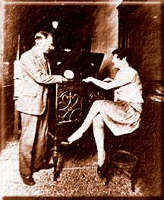
Iconoscope
Camera
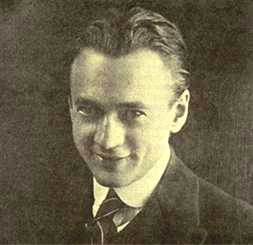
Vladmir
Zworykin
1929 Television
Additional
information concerning Vladmir Zworykin and television can be found at:
http://www.cedmagic.com/history/
https://en.wikipedia.org/wiki/Vladimir_K._Zworykin
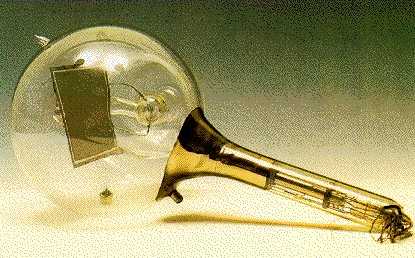
Zworykin
Iconoscope Tube circa 1932.
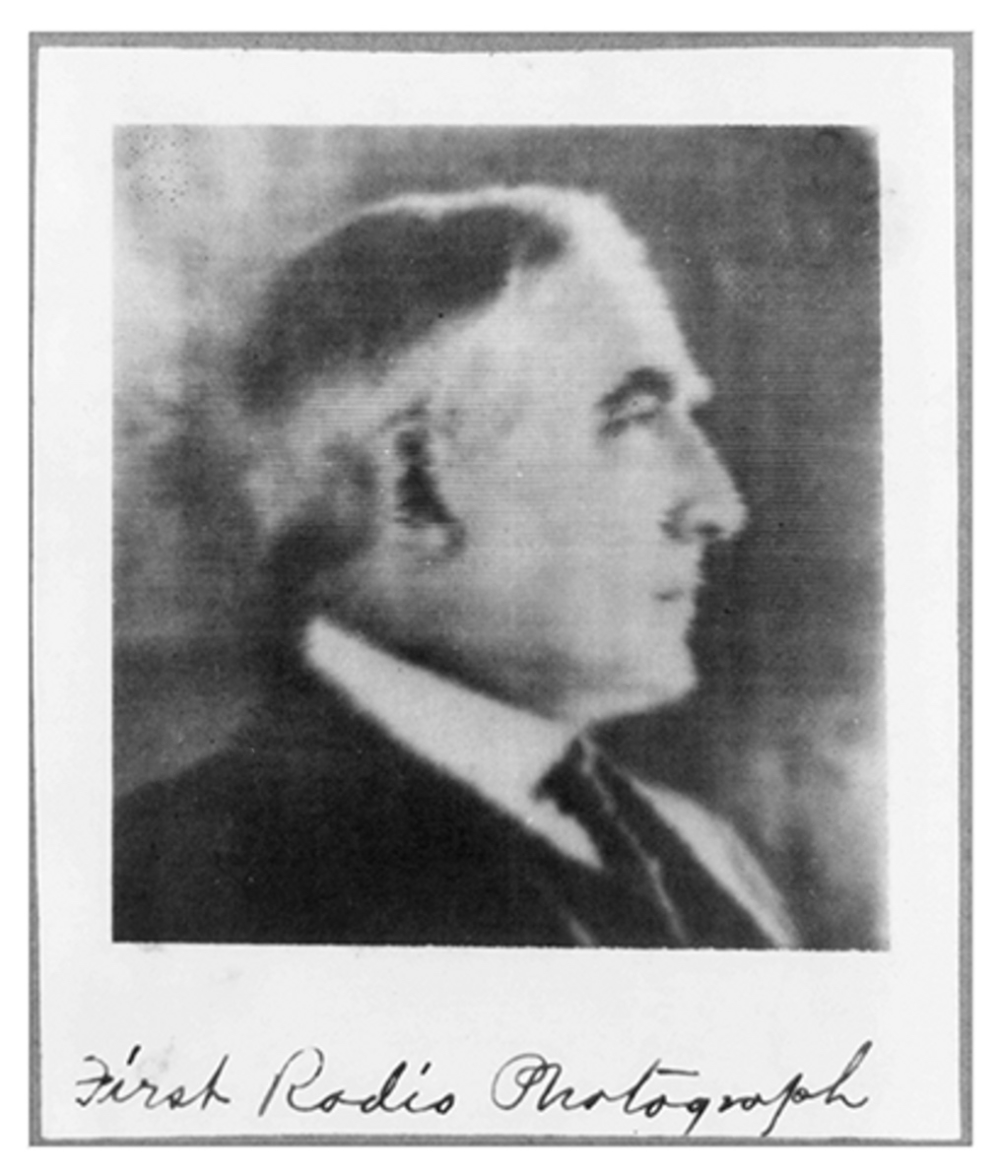
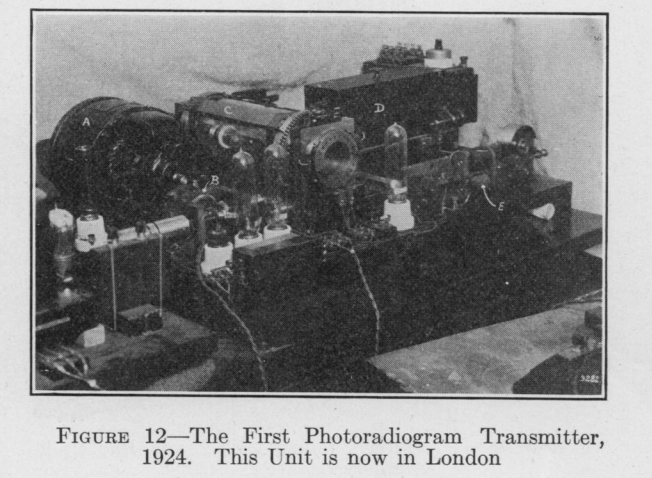
FIRST RADIO
PHOTOGRAPH LONDON TO NEW YORK - 1924. Radio photograph was where
a photograph was scanned and converted into an electrical signal that
was transmitted as a radio wave and then reconverted into an image at
the receiving end. RCA
was the first to transmit a radio photograph, a precursor to the
facsimile machine, across
the
Atlantic London to New York. The first radio photograph sent
across the Atlantic to the U.S. was a picture of President Calvin
Coolidge, transmitted from London to New York by the Radio Corporation
of America on November 28, 1924. The image was sent using a new process
called the photoradiogram system and was received in about 20 minutes.
http://everything2.com/user/shock/writeups/Radio+Corporation+of+America
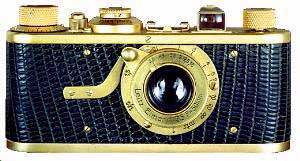
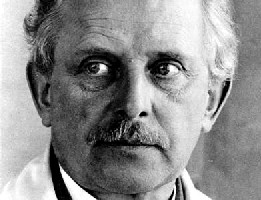
FIRST
SUCCESSFUL 35MM CAMERA - 1924. Leica
cameras
began when Oskar Barnack developed the world's first successful 35mm format camera, the
Leica
I. The Leica I camera was presented to the public for the first time at
the 1924 spring fair in Leipzig, Germany.
https://en.wikipedia.org/wiki/Leica_Camera
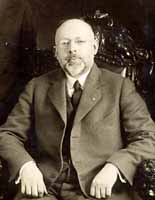
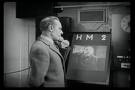
FIRST VIDEO PHONE- 1926. Dr. Herbert Ives, an American, proposed in January of 1925 speeding up an AT&T facsimile system "to the point where the product would be television." By December 1925, he had devised an electromechanical system that could transmit images from one laboratory bench to the next. Dr. Frank Gray contributed a mechanical television camera based on the flying spot system, which illuminated the subject with a rapidly moving, narrow beam of light. Harry Stoller contributed a system for keeping the transmitter and receiver synchronized. Ives first demonstrated this apparatus to AT&T executives on March 10th, 1926. The executives talked to one another via "video telephone". The picture was low-definition with 50 lines of resolution at 16 frames per second, but the image of a human face was recognizable, seen via a 2-inch-by-2 1/2-inch window.
http://www.bairdtelevision.com/Ives.html
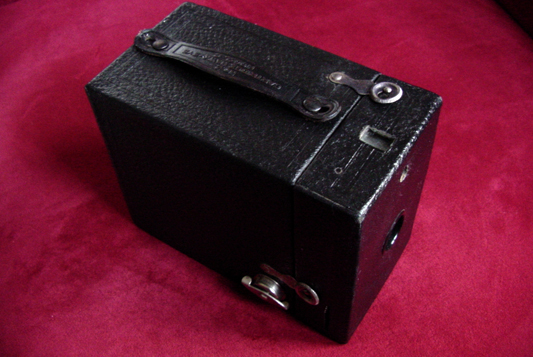
KODAK CARTRIDGE HAWK-EYE NO. 2 MODEL C - 1926. Early model box cameras are plentiful and can often be purchased in good to excellent condition at very modest prices. Every camera collection should have at least one box camera. The above camera was purchased for only $9.95.
http://www.brownie-camera.com/hawkeye.shtml
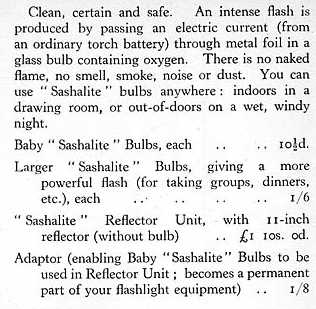
THE FLASHBULB - 1927. In 1927, General Electric invented the modern flashbulb. In the early 1930's, flashbulbs replaced dangerous flash powder techniques of illumination. The first commercially available bulb in the U.S., GE's Sashalite, was very large and contained aluminum foil surrounded by an oxygen atmosphere to increase burning of the foil. The Sashalite had a tremendous light output, nearly 180,000 lumen-seconds, necessary for the rather slow speed films of the time.
https://www.scienceandsociety.co.uk/results.asp?image=10301580
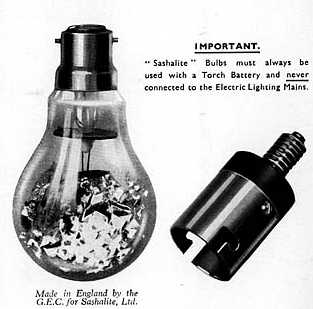

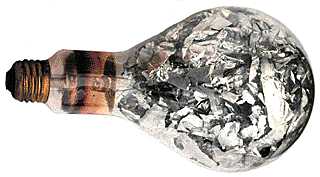
Flash Bulb Size
Variation
G.E. Mazda Photoflash Type 75
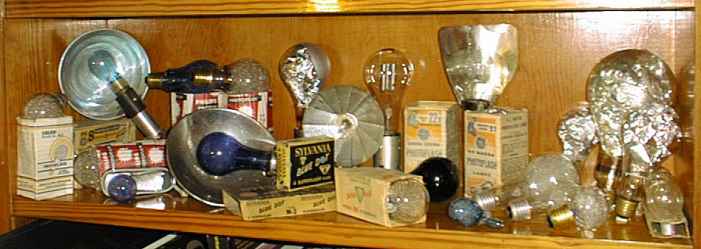
Flashbulb
collection of Christopher Anderson
Check out Christopher's excellent site to view a wide variety of topics and photographs.
http://www.darklightimagery.net/flashbulbs.html
For
interesting high-speed videos (1,000 frames/second and faster) of
how flash bulbs work, click on the link below. They are a lot
more complicated devices than you might guess.
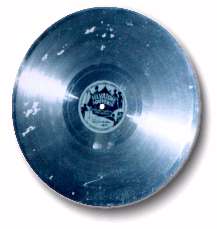
Baird Silvatone
Disc
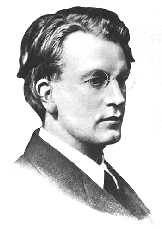
John Logie Baird
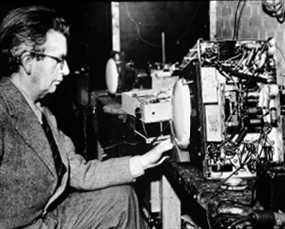
Baird with Early Television Set
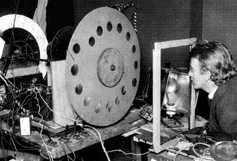
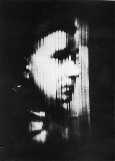
BAIRD TV - 1926.
John
Logie Baird first publicly demonstrated television on 26 January 1926,
in his small laboratory in the Soho district of London. Although
large companies with great financial support were also working on the
problem of television, Baird managed to surpass them all with very
little money, a handful of unpaid helpers, and equipment pieced
together using rather unconventional materials. For example,
Baird's choice of mechanical scanning as the most effective way of
achieving true television required the use of spinning discs - which of
financial necessity were made of hatboxes and mounted on a coffin
lid! In 1928 Baird transmitted a facial image across the Atlantic
Ocean. Additional information concerning John Logie Baird and his TV
system can be found at:
FARNSWORTH IMAGE DISSECTOR TUBE
FIRST ELECTRONIC TELEVISION - 1927.
On September 7, 1927, Philo T. Farnsworth's image
dissector camera tube transmitted an image electronically, a
simple straight line, to a receiver in another room of his laboratory
at 202 Green Street in San Francisco. Pem Farnsworth
recalled in 1985 that her husband broke the stunned silence of his lab
assistants by saying, "There you are, electronic television!"
The source of the image was a glass slide, backlit by an arc lamp.
An extremely bright source was required because of the low light
sensitivity of the design. By 1928, Farnsworth had developed the system
sufficiently to hold a demonstration for the press. His backers
had demanded to know when they would see dollars from the
invention; so the first image shown was, appropriately, a dollar
sign. In 1929, the design was further improved by elimination of
a motor-generator, which meant the television system now had no
mechanical parts. During the same year, Farnsworth transmitted the
first live human images with his system, including a 3.5 in
(89 mm) image of his wife Elma ("Pem") with her eyes closed
(possibly due to the bright lighting required).
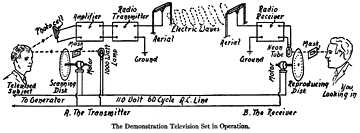
FIRST
TELEVISION TRANSMISSION IN THE U.S. - 1927.
On 8 April 1927, Bell Laboratories performed the first mechanical
television
transmission in the U.S. For additional information see:
https://en.wikipedia.org/wiki/1927_in_television
https://en.wikipedia.org/wiki/History_of_television

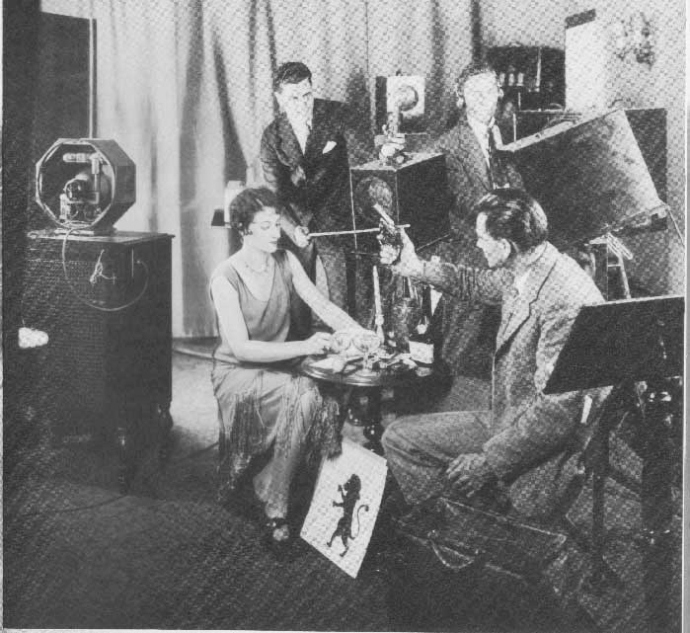
GE SCAN TV DIAGRAM -
1928
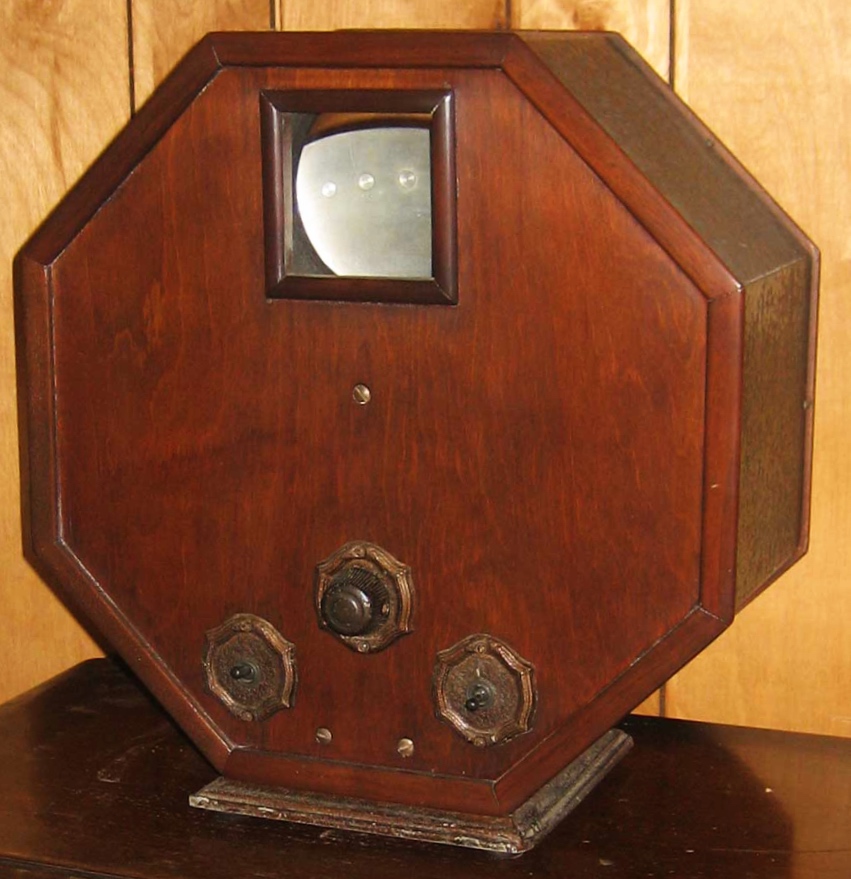
GE OCTAGON TV SET
-1928
IMAGE
FROM 'THE QUEEN'S MESSENGER' - 1928
https://en.wikipedia.org/wiki/Mechanical_television
https://www.earlytelevision.org/ge_octagon.html
https://www.earlytelevision.org/queens_messenger.html

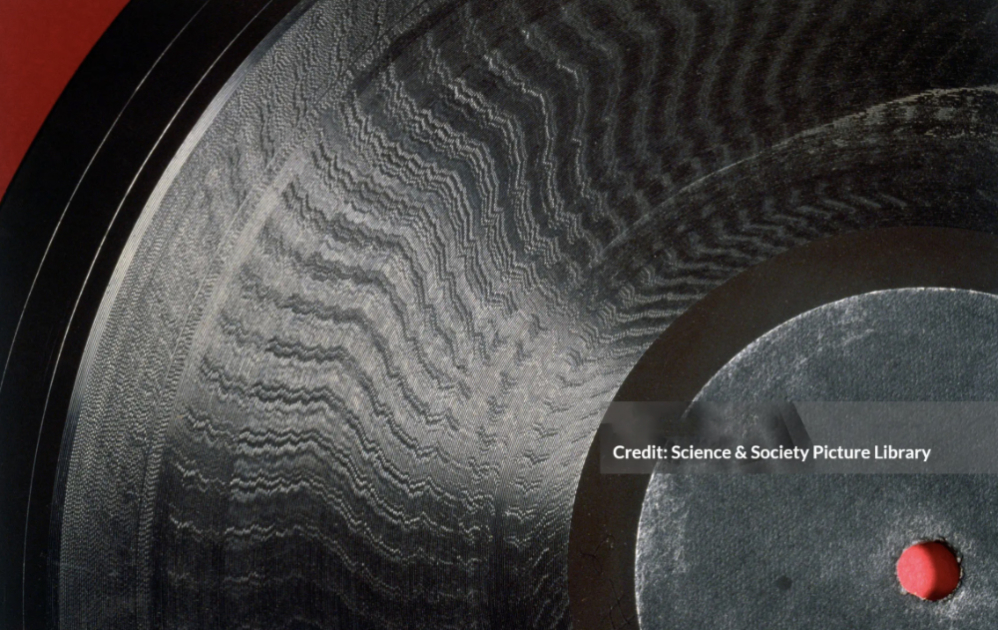
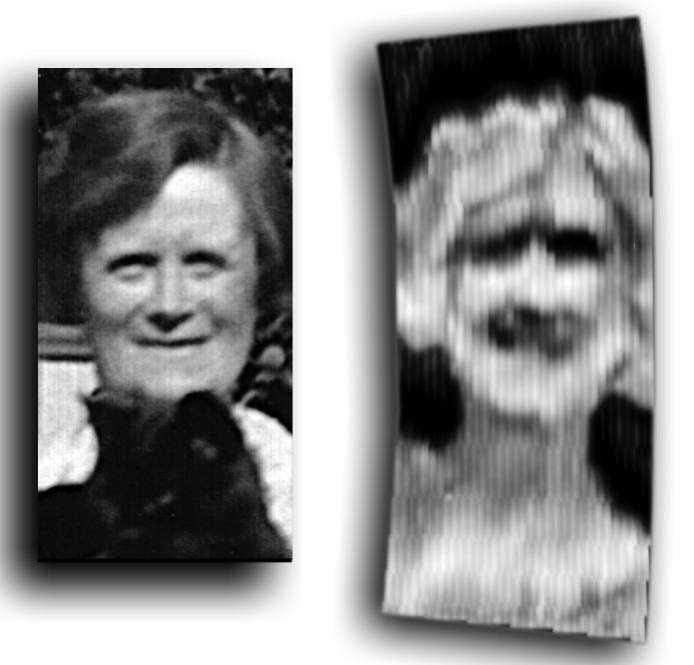
PHONOVISION DISK PHONOVISION DISK , ENLARGED PHOTO AS SHOWN BY A PHONOVISION DISK
PHONOVISION, THE JOHN LOGIE BAIRD PHONODISC AND TV- 1928. The first videodisc, the Phonodisc, was developed by Scottish inventor John Logie Baird. It was a 250 mm, 78 rpm record, similar to the discs being produced for sound recording at that time. A 30-line television signal was recorded on the Phonodisc. The earliest known consumer recording of a TV broadcast (1933) was onto a Baird Phonodisc. The Phonodisc was not a commercial success and was abandoned in 1936.
https://en.wikipedia.org/wiki/Phonovision
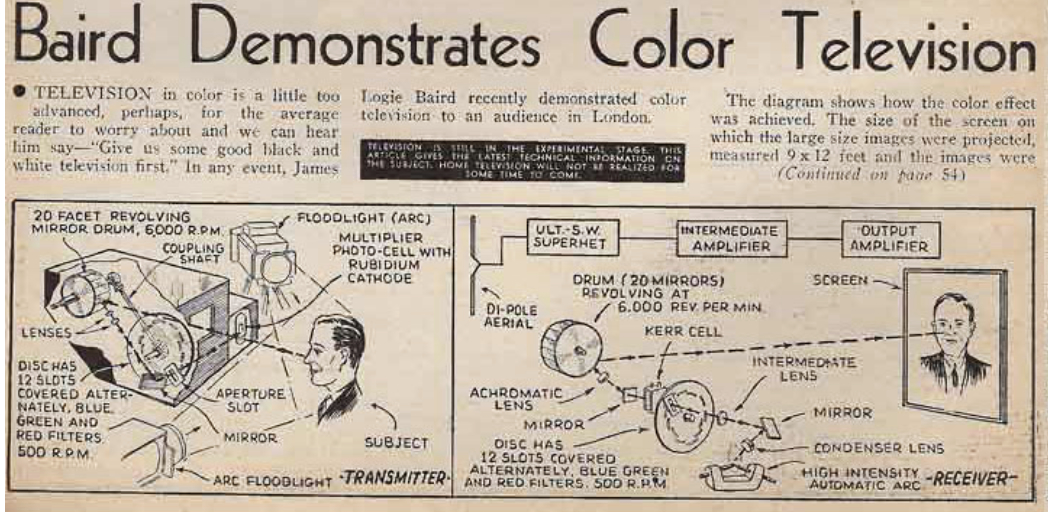
BAIRD MECHANICAL COLOR TV
SYSTEM
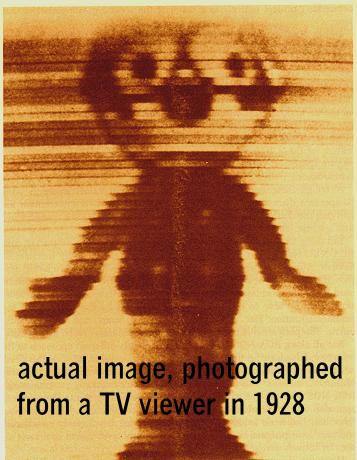
FELIX
THE CAT
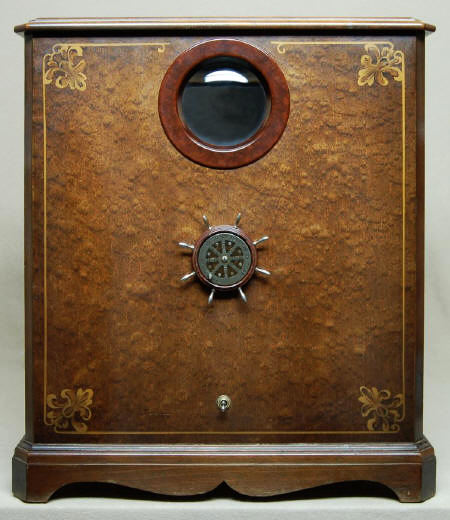
VISIONETTE TV
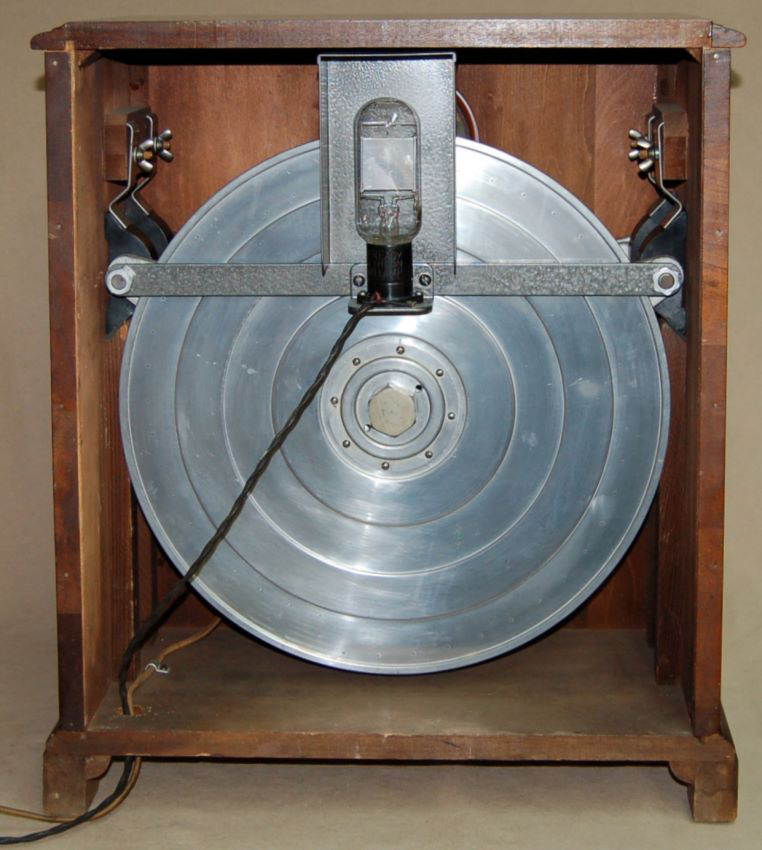
VISIONETTE TV, REAR
VIEW
COLOR TELEVISION - 1928.
The first color TV system was developed by John Logie Baird in
1928 using a mechanical process. One of the first pictures ever
broadcast in the US was a 60 line still image of "FELIX" the
cat by RCA-NBC in 1928. The image would be seen in an orangish-red
color. On June 27, 1929 a public demonstration of color TV was
held by H. E. Ives and his colleagues at Bell Telephone Laboratories in
New York. The first images were a bouquet of roses and an American
flag. A mechanical system was used to transmit 50-line color television
images between New York and Washington. In 1929, Western Television Corp.
marketed a mechanical scanning disk TV, the Visionette, one of the first factory built
mechanical televisions. To view the crude pictures on this
machine required a radio receiver and an additional
amplifier to boost the signals to a high enough level to excite
the large neon "image tube" behind the viewing lens. If you wanted
sound, that required another radio to tune in the sound channel. The
device had a resolution of 45 lines (15 lines triple interlaced).
https://www.earlytelevision.org/baird_mechanical_color.html
https://completeseries.wordpress.com/2015/06/27/today-in-television-history-1929-the-first-color-television-demo-in-new-york-city/
https://www.earlytelevision.org/mechanical.html
https://www.earlytelevision.org/color.html
1920s