
1930s
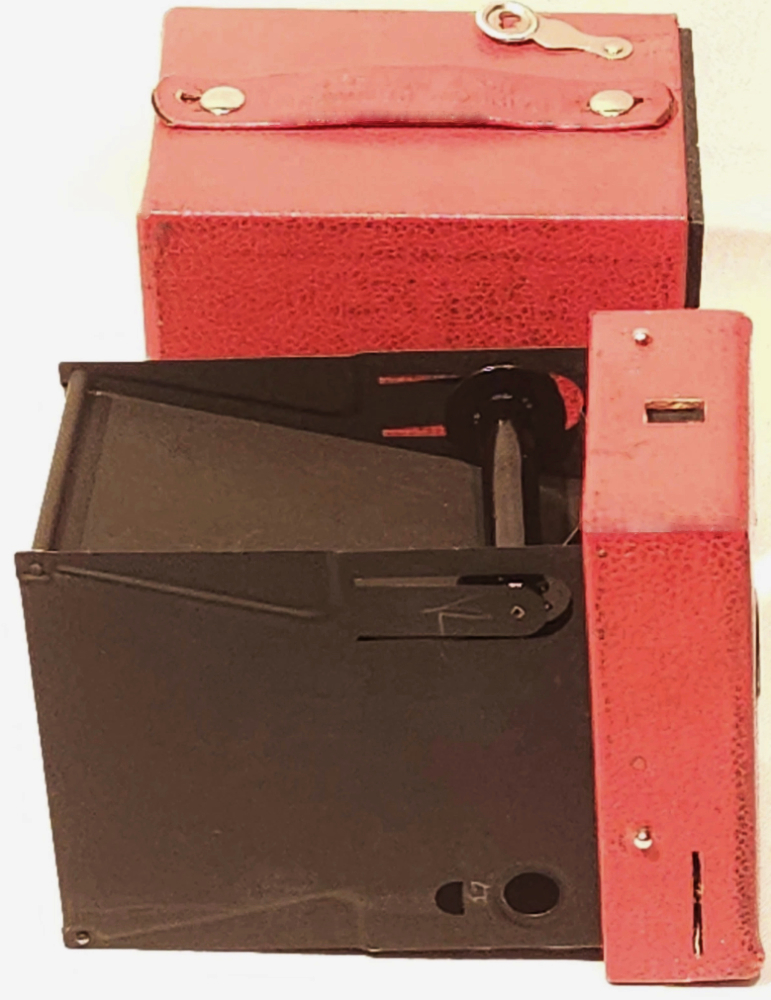
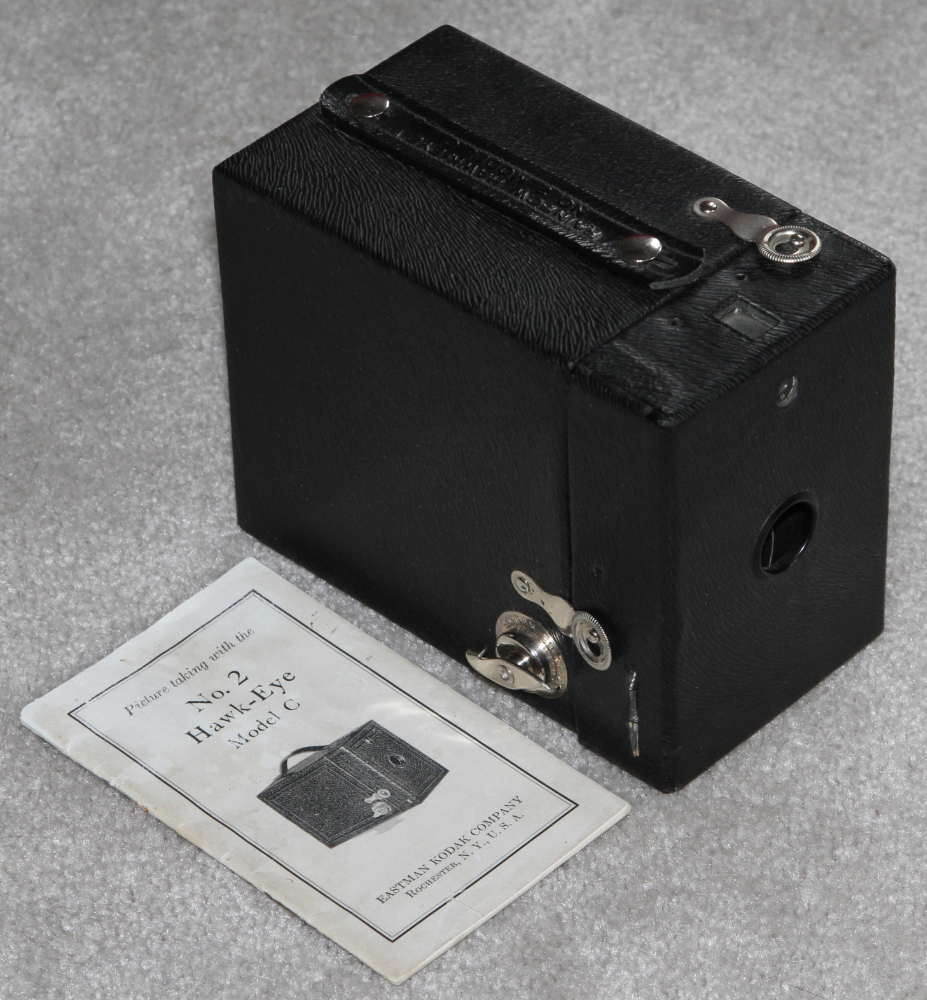
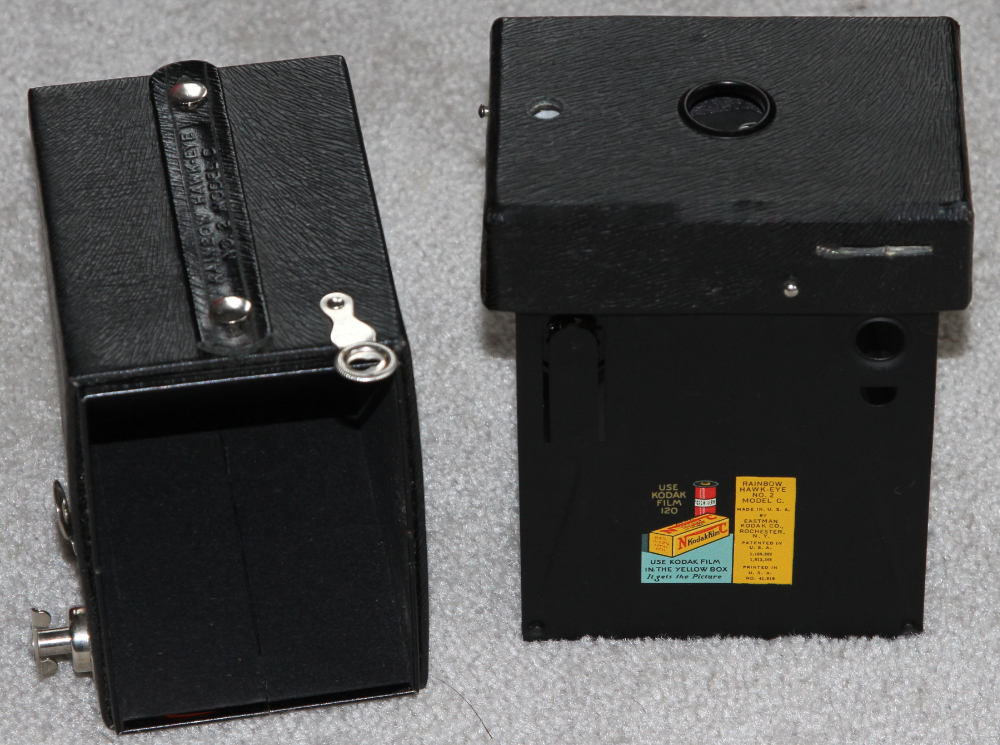
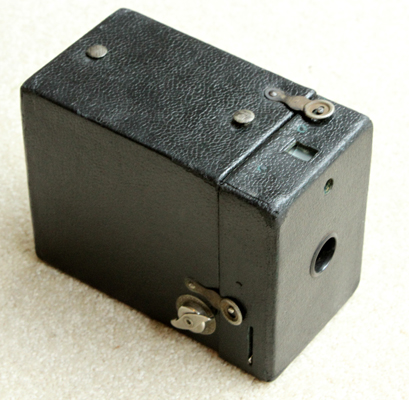
KODAK No. 2 RAINBOW HAWK-EYE, MODEL C - 1930-1933. The No. 2 Rainbow Hawk-Eye C was most likely sold as a camera for kids as it was of the simplest possible design and with a cardboard body. The one above on the upper left is more typical of older Kodak cameras as it has corroded metal works and a missing handle. It was available in a range of colors. In common with many similar Hawk-Eye box cameras, the only identification is on the strap. Printed inside is the instruction, "Use Kodak Film is 120" (see label above on camera interior) which is still avaliable at present. The camera on the upper left was purchased many years ago on eBay for $1. The lower black Hawk-Eye was purchased in March of 2025 on eBay for $13 and is in excellent condition, appering to be nine months old rather than 90 years old. Shutter still works very well. Interior looks new. The red Hawk-Eye was obtained in December of 2025 for $45. The outer shell is made of metal covered with red leatherette. The model C has only one viewfinder unlike the usual Kodak box cameras that have 2 viewvinders (one for each orientation, portrait and landscape). This is because it was advertised as a "portrait" camera, thus only needed one viewfinder. Similar to other Kodak box cameras, the image quality is marginal, and the viewfinder is not easy to use even outdoors in daylight. MSRP $1.00 for cardboard black. (about $19 in 2025), possibly around $5.50 for red model with metal case.
A word to the wise
for both buyers and sellers, especially sellers. If you want to
get the best price for your camera you should take the trouble to clean
it as best you can. We have received many cameras over the years
that, when thoroughly cleaned and with minor repairs, appeared to be
much more valuable than the price we paid. One good example is
the Mamiya C22 0f 1966-68 that we paid a total of $73 for with a very
nice lens, but a trash-ready C22 body. With a lot of elbow
grease and a little paint repair it now compares to those selling for
$200-250. Another example is the red Kodak Rainbow Hawk-Eye 2C
shown above. It was purchased for $45, including shipping.
In the eBay ad the camera seemed to have very clean hardware as well as
a grip in perfect shape, so we bought it wondering why the seller
hadn't asked for more (he described it as being in very good
condition). When it arrived we found that the bottom had many
black marks as did some of the side areas. This most likely
convinced the seller that he couldn't ask $150 or more as some similar
cameras in near perfect condition are selling for. We tried
several strong cleaners on the black marks with no success.
Perhaps the seller had done so also and decided that $45 was the market
value of the camera. However, we then tried a solvent called
"Goof Off." It worked miracles. Every bit of
the black marks were removed and we now have a camera that appears nine
months old rather than ninety years old. If selling, we
would would require at least $125 for this now near perfect camera.
http://www.brownie-camera.com/hawkeye.shtml
http://camerapedia.wikia.com/wiki/Hawk-eye_No._2
http://ericconstantineau.com/photo/review_kodakrainbow_en.html
https://kodak.3106.net/index.php?p=214&cam=1149
https://www.youtube.com/watch?v=3vBK3PJ2D0Y (Video)
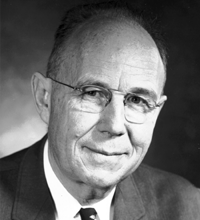
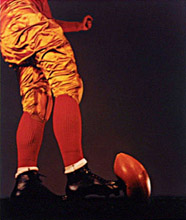
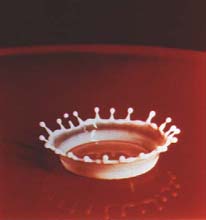
1. Harold Edgerton 2. The Kick - 1934 3. Milk Drop Coronet - 1957
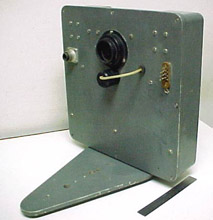
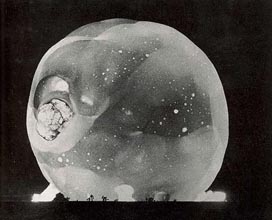
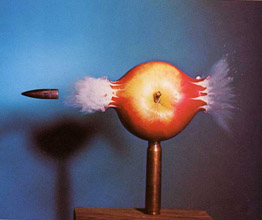

4. Rapatronic Camera 5. Atomic Blast 6. Bullet in Flight
ELECTRONIC FLASH PHOTOGRAPHY - 1931. Harold Edgerton, an American researcher and inventor, made electronic flash photography a reality in 1931 when he invented a stroboscopic light for use in both ultra-high-speed and still photography. The discovery was announced in the May issue of Electrical Engineering. Edgerton was also a pioneer in the use of high-speed electronic flash with this work in the 1940s. Edgerton became the first to illuminate nighttime landscapes and darkened interiors, and his technology was capable of freezing the quickest of actions. In 1968 Edgerton joined with Jacques Cousteau in underwater exploration, producing the first underwater time-lapse photography. The atomic blast photo above was taken using another of Edgerton's inventions, the Rapatronic camera - capable of taking photographs with exposure times of 10 nanoseconds (10 billionths of a second).
https://en.wikipedia.org/wiki/Doc_Edgerton
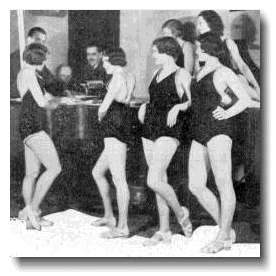 BAIRD SILVATONE
DISC TV RECORDING - 1933. Oldest known consumer
recording of a TV broadcast. A British citizen made a 1933 recording of
a BBC transmission onto a Baird 30-line system Silvatone disk (see 1928 - John
Logie Baird). The recording was made at the owner's home in Ealing, England,
using domestic equipment connected to a wireless receiver tuned to the BBC's
vision (TV) transmission in the Medium Wave band. The recording included
a dancing group called the Paramount Astoria Girls.
BAIRD SILVATONE
DISC TV RECORDING - 1933. Oldest known consumer
recording of a TV broadcast. A British citizen made a 1933 recording of
a BBC transmission onto a Baird 30-line system Silvatone disk (see 1928 - John
Logie Baird). The recording was made at the owner's home in Ealing, England,
using domestic equipment connected to a wireless receiver tuned to the BBC's
vision (TV) transmission in the Medium Wave band. The recording included
a dancing group called the Paramount Astoria Girls.
https://en.wikipedia.org/wiki/Phonovision
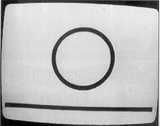 TV
TEST PATTERN - 1934. Test pattern by
the BBC. The first ever television test pattern, this
very simple pattern was broadcast by the BBC in 1934 using Baird's 30
line
TV system.
TV
TEST PATTERN - 1934. Test pattern by
the BBC. The first ever television test pattern, this
very simple pattern was broadcast by the BBC in 1934 using Baird's 30
line
TV system.
https://www.wikiwand.com/en/List_of_BBC_test_cards
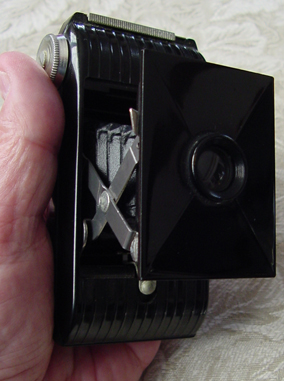
KODAK BANTAM - 1935. Example
of an inexpensive pocket-sized bellows camera of the 1930's. For those
interested in beginning a camera collection of their own, there are
many cameras such as this available in excellent condition at very low
prices. The above camera appears to have never been used and was
purchased for just $4.99.
http://camerapedia.wikia.com/wiki/Kodak_Bantam
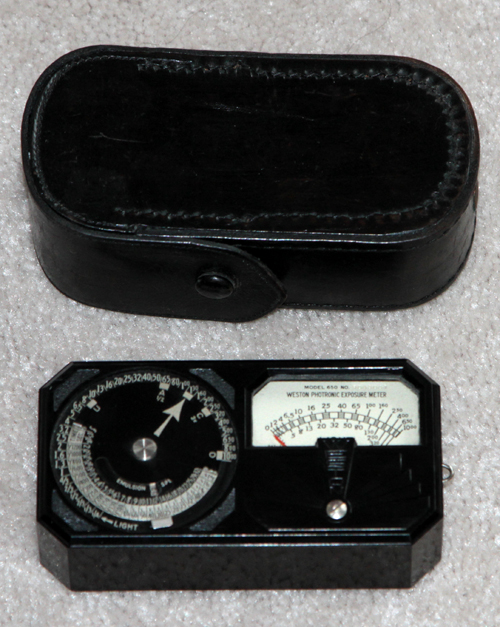
WESTON MODEL 650 - 1935-39. One of Weston's earliest light meters and rather unique due to its shape. This sample is noteworthy because of its excellent appearance and that fact that it still works properly. Original MSRP $15.95 (about $256 in 2011 dollars).
http://ian-partridge.com/west650.html
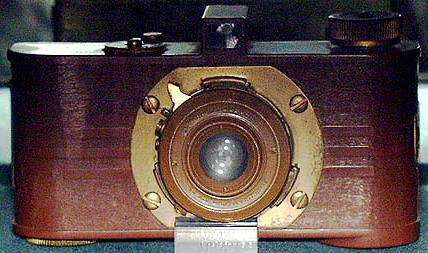
ARGUS
MODEL A - 1936. The first Argus
camera,
known as the Model A, was manufactured in Ann Arbor, Michigan in 1936.
It was a success as the first low-cost, easy-to-use 35mm film camera in
the world. Thirty thousand cameras were sold in the first week at
$12.50
each. Worldwide sales of this model continued until 1950. The
popularity
of the Model A influenced Kodak to switch their film manufacturing from
127 to a 35mm format, which remains the dominant film in use
today. In addition to the brown and gold model shown here, it also came in
black
and gold, olive drab, and gray.
https://www.arguscg.org/reference/a.shtml
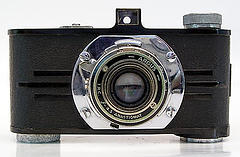
ARGUS MODEL AF - 1937-38. The Argus A was followed by the AF (Auto Focus) model in 1937 which incorporated a constant focusing mechanism rather than the standard two position focusing settings of the more common A. Other than that, the A and the AF are the same camera.
The original MSRP for the AF model was $15. In 2009 dollars that would be about $222.
http://www.camerapedia.org/wiki/Argus_AF
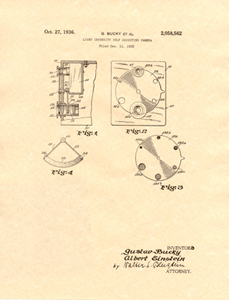
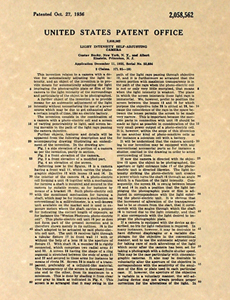
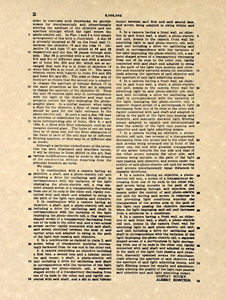
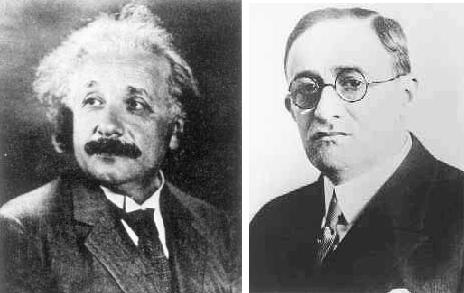
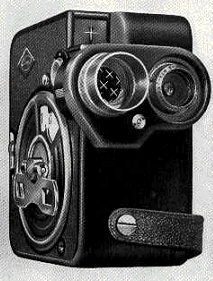
EINSTEIN / BUCKY CAMERA DESIGN - 1936.
In 1936 Albert Einstein and Gustav Bucky patented a design for a camera
with a photo-electric cell to operate a mechanism to reduce the
intensity of the light striking the film (copy of patent above). Two
mechanisms were described: 1) a shade of varying transparency to be
moved in front of the film, and 2) a mechanism to rotate a plate with
various sized holes. According to Sean Johnston of the University of
Glasgow, the Eumig C-2 marketed in Austria in 1935, was the First to
incorporate a photoelectric meter coupled to a lens aperture (above
right). A History of Light and Color Measurement, page 229 of HTML
version, Sean F. Johnston, University of Glasgow, UK
http://www.bekkoame.ne.jp/~o-pat/english2.htm
The
1936 Berlin Olympic Games were the first to be broadcast by electronic
television cameras.
https://en.wikipedia.org/wiki/Olympics_on_television
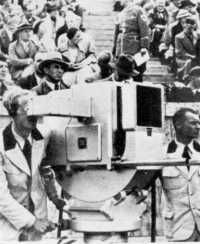
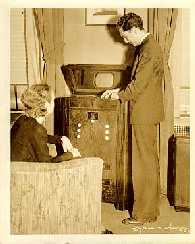
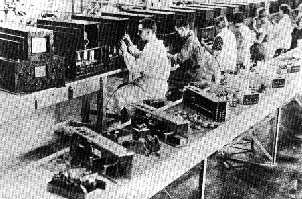
TV
Camera at Olympics RCA TV Set Circa
1936
1935 German TV Production Line
Click
for Larger
View
Click
for Larger View
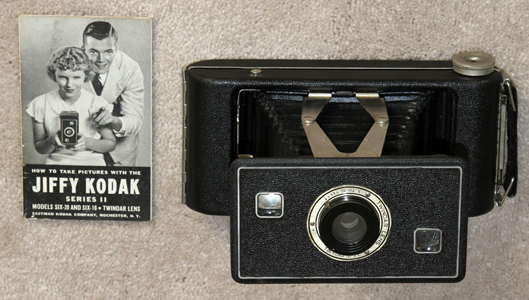
KODAK JIFFY SIX-20, SERIES II - 1937-1942. This camera is unusual in that it has two viewfinders, one for landscape photos and one for portrait photos. The original MSRP in 1937 was $10 which would about $150 in 2010 dollars. The above camera was part of a well-maintained collection which is why it and the maual are still in excellent condition after more than 70 years. It and the manual were obtained on eBay for $14.99, a refreshing experience since many original manuals are now sold separately for $20 or more.
http://www.camerapedia.org/wiki/Jiffy_Kodak_Series_II
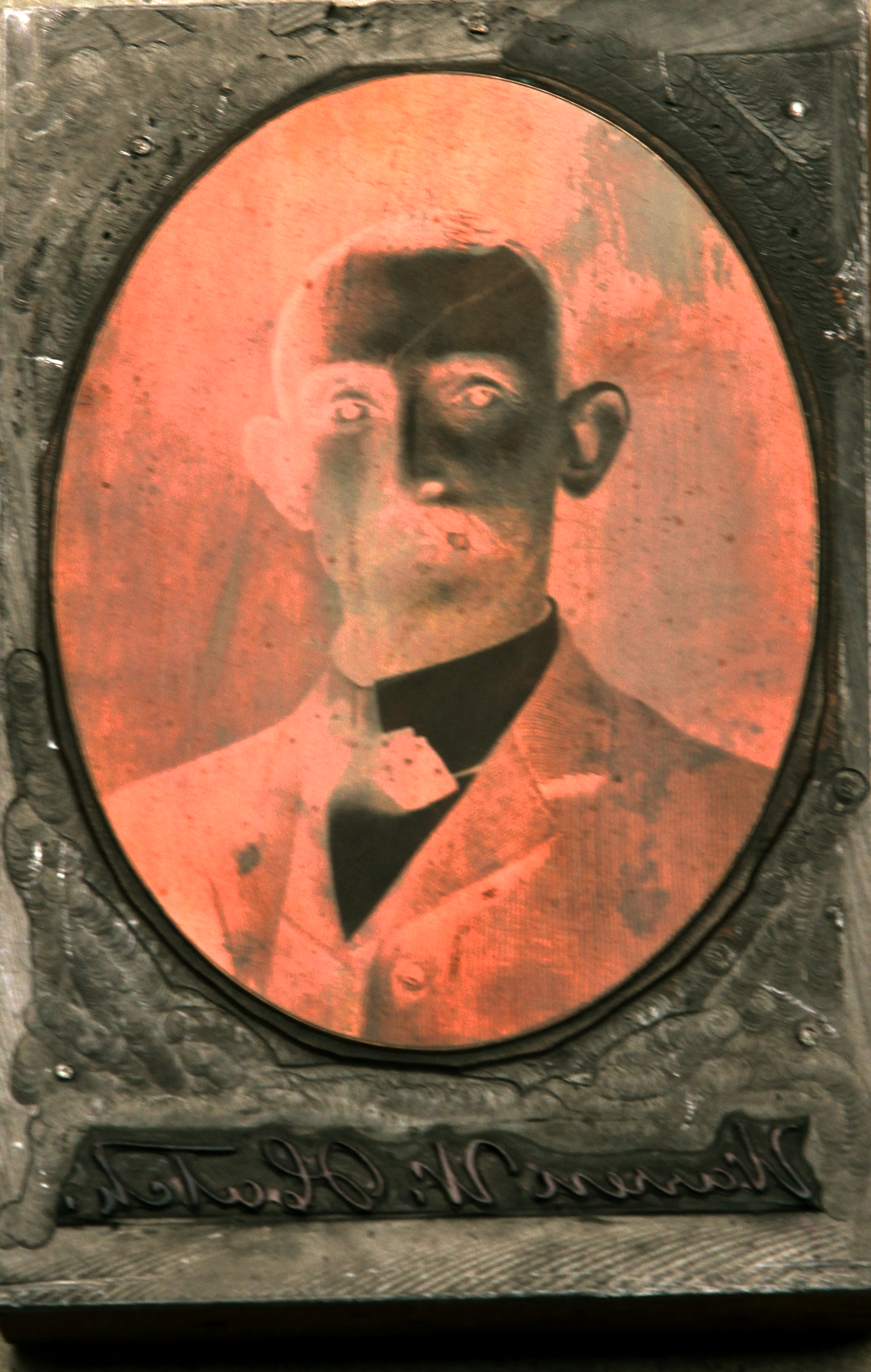
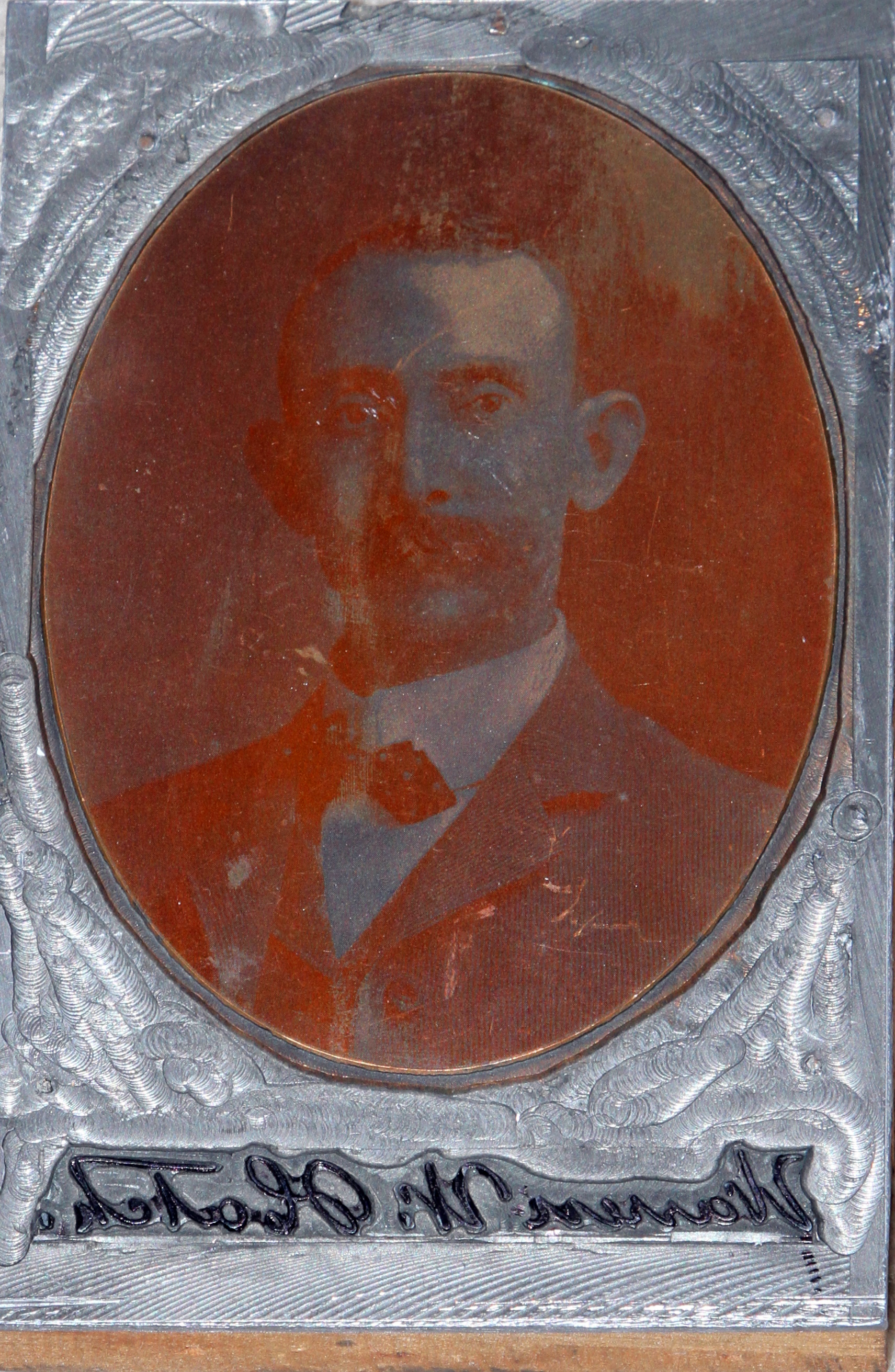
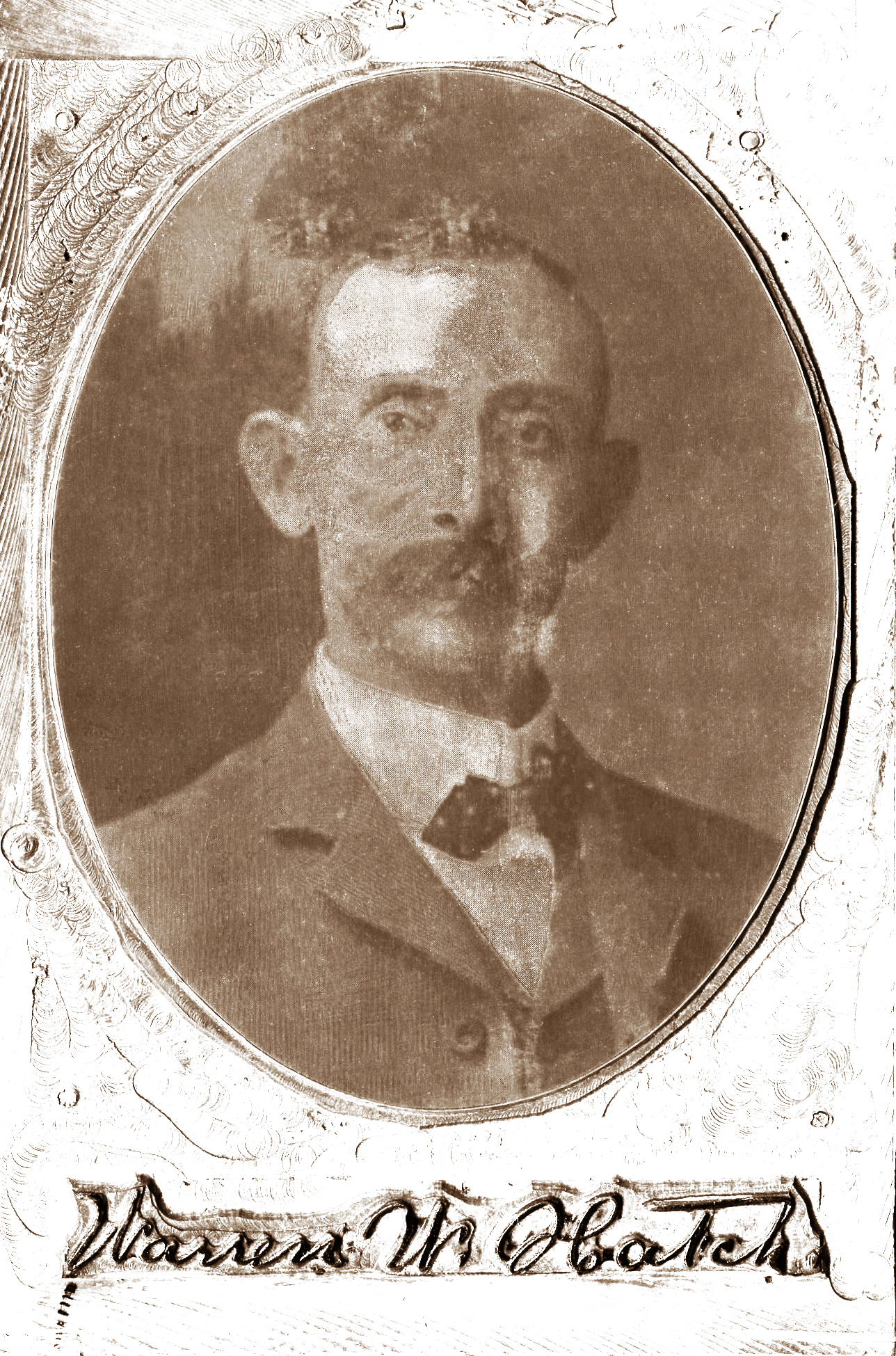
Many thanks to Terry Wedge for the above Information concerning the letterpress printing process.
KODAK CINE 16 - 1936. Kodak is well known for inexpensive still cameras and 8 mm movie cameras, but they also produced many inexpensive 16 mm movie cameras over the years. The Cine 16 came with a standard Kodak Anastigmatic F1.9 25mm lens. It had a leatherette style body with a carrying handle that doubled as a viewfinder and a wind-up motor. It could hold a 100 foot magazine of 16 mm film. MSRP with case was $125 ($2,100 in 2013 dollars).
https://en.wikipedia.org/wiki/Cine-Kodak
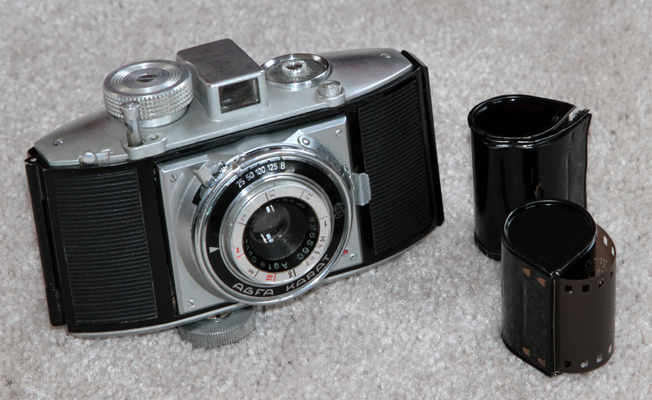
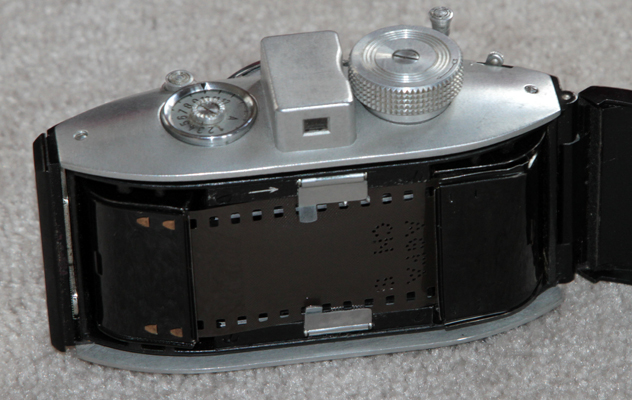
Agfa Karat 4.5 - 1938. One of many Agfa Karat cameras produced from 1938 through the 1950s. They are generally identified by the lens: 3.5 Compur, 4.5 Oppar, etc., but there were several different lenses used in the same model and the exterior appeance also varied between cameras with the same lens, thus it is not always easy for the amateur to determine which variation he has and the year of manufacturer. The unique characteristic of the Carat models produced up through 1947 was the use of a film loading system that involved cogs in the center rear of the camera that forced the film to move into the empty cassette on the right rather than being pulled into the cassette as was standardl for 35mm cameras. In 1948 and after the Karat cameras use the standard system still used today to load 35mm cameras.
http://camerpedia.wikia.com/wiki/Agfa_Karat
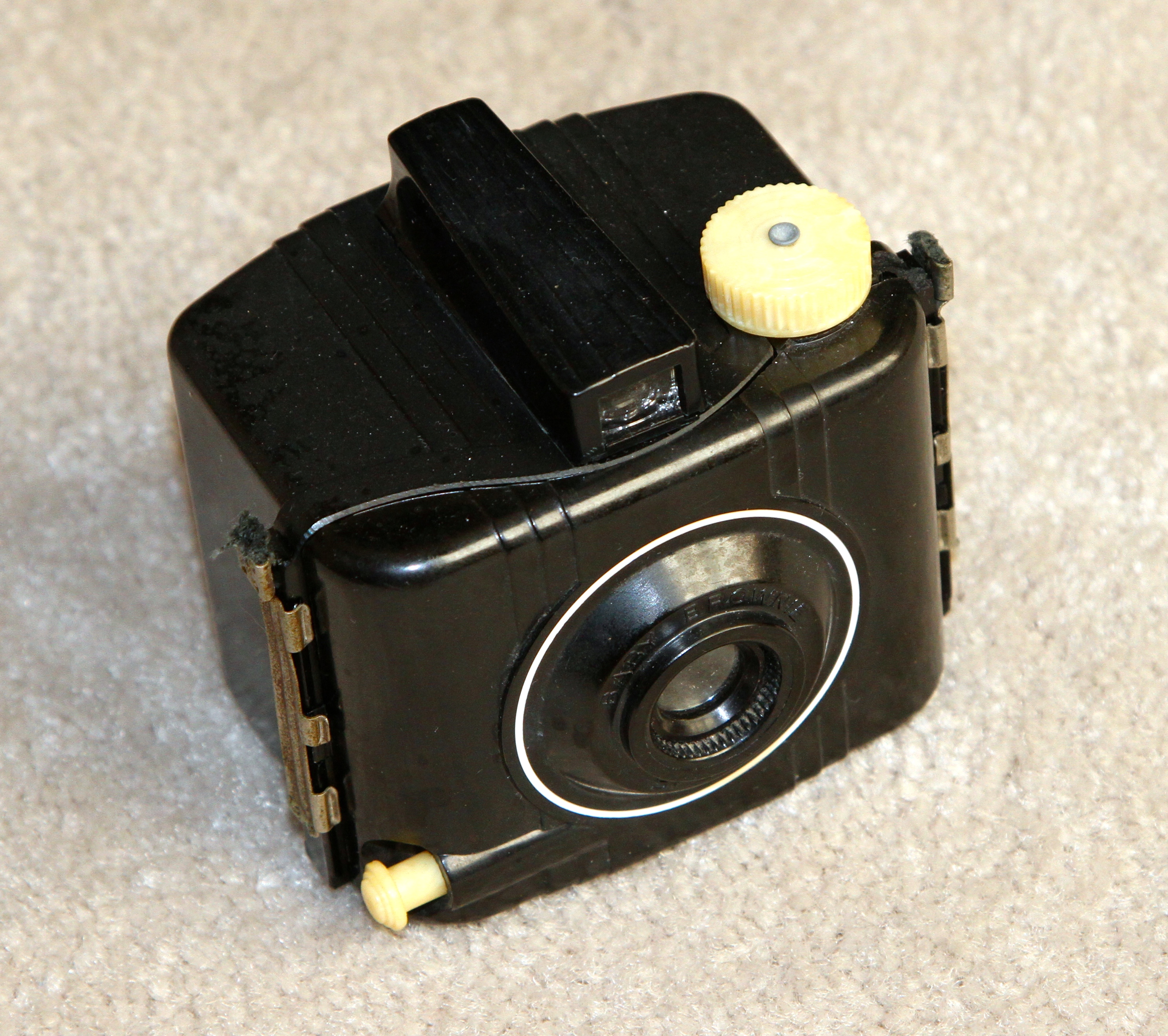
A VERY SPECIAL KODAK BABY BROWNIE SPECIAL - 1938-54.
This Brownie belonged to Norman Breslow and his wife. Yes, the
same Norman Breslow who was the originator of the process for digitally
altering photos prior to the development of apps for doing such artwork
and who is shown on our 1991 page. Norman didn't use this camera
for any of his projects, but the mere fact that he owned it makes it a
collectible item. The Brownie Special was a Bakelite, 127 film
camera. Original MSRP was $1.25, about $21 in 2015
dollars.
http://camerapedia.wikia.com/wiki/Kodak_Baby_Brownie_Special
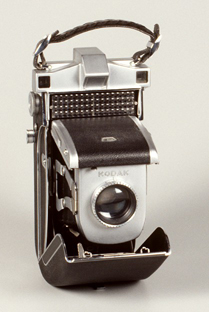
KODAK SUPER SIX-20 - 1938. The Super Six-20 was the first still camera with autoexposure. It was very expensive for that era and relatively few were sold. Production: 1938-1944, 719 were manufactured. 620 roll film. MSRP $225 (about $3,600 in 2012 dollars). Kodak workers called it the "boomerang" because of its unreliability and subsequent many returns for service. Information provided by Todd Gustavson, curator, Technology Collection, George Eastman House. Due to its limited production, sellers request what would normally be considered outrageous prices for early Kodak models. Some items such as the six-20 take on a cult status among collectors and thus demand premium prices far beyond what their availibity would suggest (about 719 or so). We have cameras in our collection that were produced in far fewer numbers, or are even unique, but were obtained for far less than current asking prices for the six-20. In 2012, eBay asking prices ranged from about $2,400 to $2,800.
https://www.eastman.org/search-collections
http://camera-wiki.org/wiki/Kodak_Super_Six-20
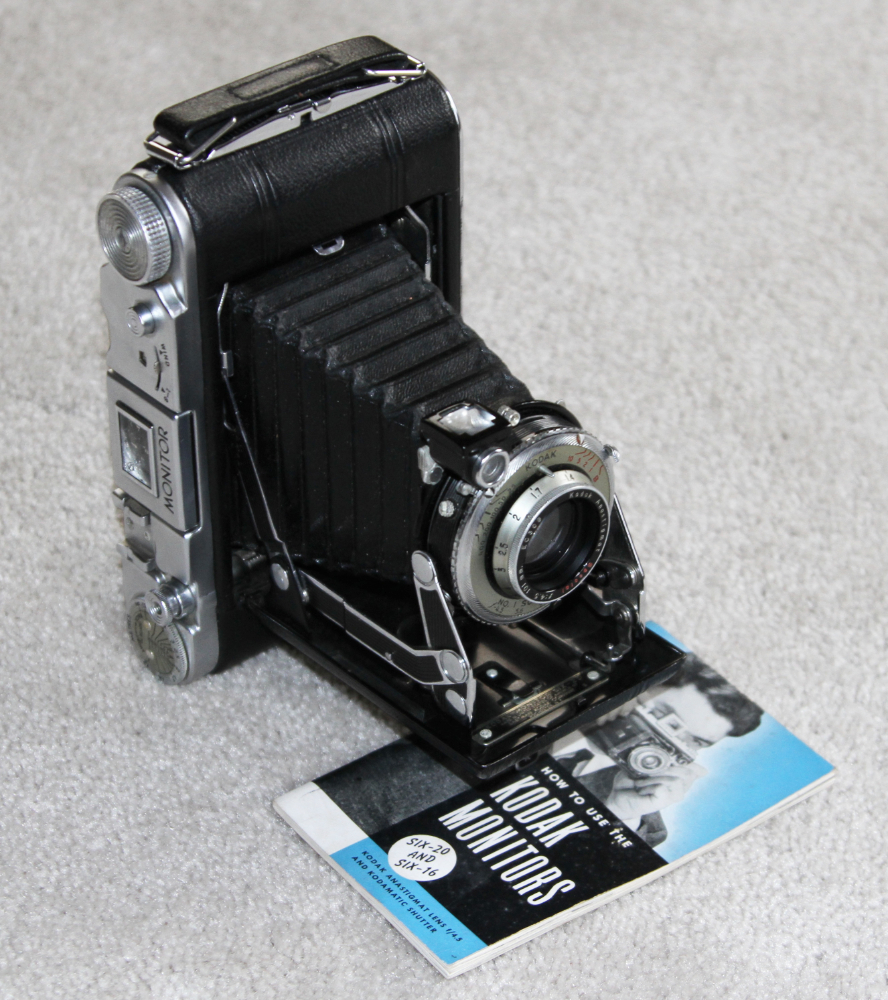
KODAK MONITOR SIX-20 / SIX-16 - 1939-48.
A Monitor Six-20 was donated by our good friend Joan Klonowski of
Grants New Mexico.
Although the case shows signs of being carried around a lot, the camera
itself is in near pristine condition, including the
bellows.
Lens: Kodak Anastigmatic Special 101mm f4.5-32. Shutter:
Supermatic B-1/400 sec. With the exception of the very rare and
fragile Kodak Super Six-20, the Monitors are perhaps the most
sophisticated American Kodak folding cameras of the 1930s and 1940s. The Six-20
used 620 roll film and the Six-16 used 616 roll film. The Monitor
Six-16 originally sold for $48.50 and the Monitor Six-20 for $66.00.
Presumably, the Six-20 price was for the more expensive lens (the
Anastigmat Special) as excepting for the dimensional differences of the
two film formats, the cameras are identical. They are solid and
very well made.
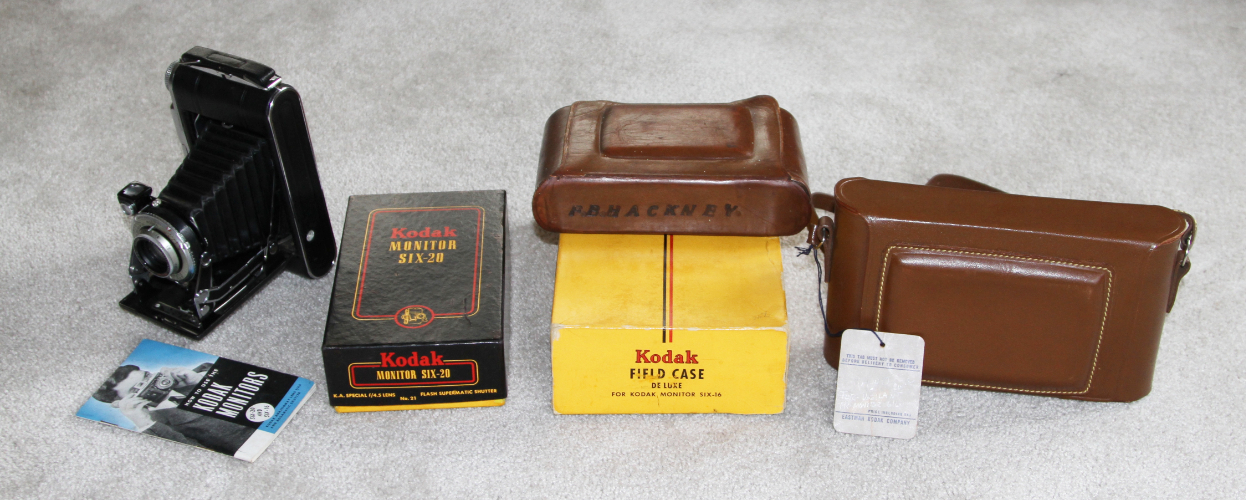
Update 1:
Like most collectors, we like to have as much of the original items
that came with a camera as possible. First, we ordered an
original manual from Craig for a total of $21.70. Unbelievably,
when searching
for a case in better condition than the one that came with this 1939
camera, we found a brand new case in its original box with the original
Kodak price tag of $7.40! Of course, we didn't get it for $7.40,
but instead a total of $47.90 including shipping. We also found
an origial box for the camera which cost us an additional $23.45. So this
"free"
camera ended up costing us a total of $93.05, but we feel it was well
worth it
because of the near mint condition of the camera itself. Such a
well-preserved product of yesteryear deserves a fine case and its
original manual. We will retain the case that came with the
camera as it may have some historic value. The name F.B. Hackney
was imprinted on the case in several places and that person might have
been the original owner of the camera which is seventy years old
or older. We did a search for a Frank B. Hackney and found a
person with that name who died in 1993 and lived in Grants New
Mexico. If he was indeed the owner of the camera we now have, we
would be interested in knowing if he purchased the camera new and what
his occupation was.
Moral of the story: Beware of Greeks and a Klonowski bearing gifts!
Update 2:
Joan has confirmed that she purchased the Six-20 at a farm auction in
Grants New Mexico. It appears then that Frank Hackney was the
owner and that he was a farmer. Thanks to Frank for taking such
good care of his camera. We believe that he would be pleased to
know that his camera is now a treasured part of a collection and that
it is high-lighted on a camera photography web site.
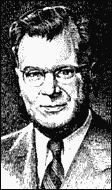 Chester
F. Carlson and Electrophotography - 1938.
Electrophotography (Xerography) was invented by Chester F.
Carlson.
While others sought chemical or photographic solutions to instant
copying
problems, Carlson turned to electrostatics and in 1938 succeeded in
obtaining
his first dry-copy, and the first of many patents two years
later.
It took presentations to more than 20 companies before Carlson was able
to interest the Battelle Development Corporation in his invention in
1944.
In 1947 the Haloid Company, later renamed Xerox Corporation, negotiated
commercial rights to his xerographic development. Eleven years
later,
and just 10 years before his death in 1968, Xerox introduced its first office copier
Chester
F. Carlson and Electrophotography - 1938.
Electrophotography (Xerography) was invented by Chester F.
Carlson.
While others sought chemical or photographic solutions to instant
copying
problems, Carlson turned to electrostatics and in 1938 succeeded in
obtaining
his first dry-copy, and the first of many patents two years
later.
It took presentations to more than 20 companies before Carlson was able
to interest the Battelle Development Corporation in his invention in
1944.
In 1947 the Haloid Company, later renamed Xerox Corporation, negotiated
commercial rights to his xerographic development. Eleven years
later,
and just 10 years before his death in 1968, Xerox introduced its first office copier
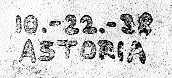
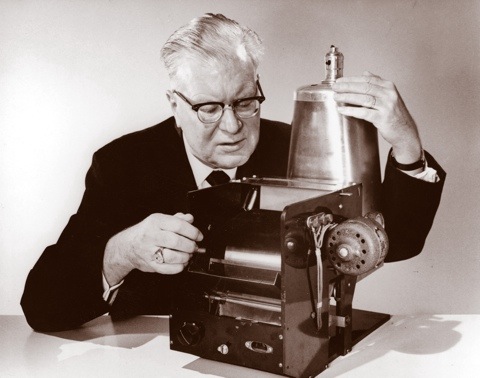 On October 22, 1938, Carlson, working with his assistant Otto Kornei,
produced the first ever Xerographic image shown above left (with the
word Astoria). Photo directly above shows Mr. Carlson with
prototype copier. Additional
information concerning Chester Carson and copiers can be found at:
On October 22, 1938, Carlson, working with his assistant Otto Kornei,
produced the first ever Xerographic image shown above left (with the
word Astoria). Photo directly above shows Mr. Carlson with
prototype copier. Additional
information concerning Chester Carson and copiers can be found at:
https://en.wikipedia.org/wiki/Chester_Carlson
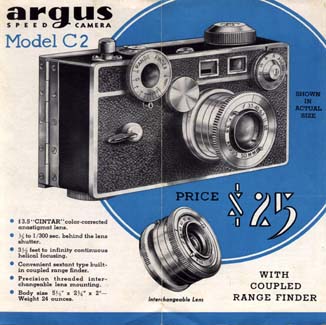
ARGUS C and C2 - 1938. The Argus C and C2 models were affectionally known as the" brick". Millions were sold thereby contributing to the Argus Model A affect on film sales which resulted in 35mm film camera domination of the consumer market.
https://www.arguscg.org/reference/a.shtml
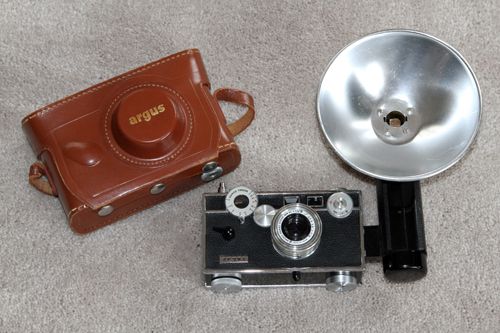
ARGUS C3 - 1939-66. The black C3 shown above is considered the classic C3 as it was produced for so many years with only minor changes, however, there were many other C3 variations produced from time to time, often with only cosmetic changes. The C3 is very common due to the large number sold and their durability. They can often be found in near pristine condition at very reasonable prices. The above camera in excellent condition with case and flash was purchased for only $29. Many collectors specialize in Argus cameras only, and there is a collector's club just for owners of Argus cameras.
Prices and inflation: A 1959 ad for the C3 had a price of $39.95. In 1939 dollars that would be about $19. In 2009 dollars that would be about $290. That second figure makes the $29 spent for the above camera to seem to be even more of a bargain.
http:/?en.wikipedia.org/wiki/Argus_C3
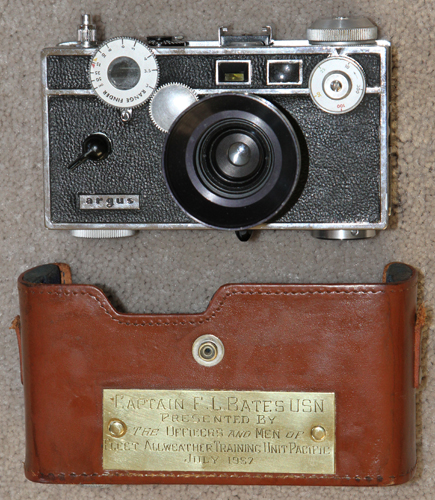

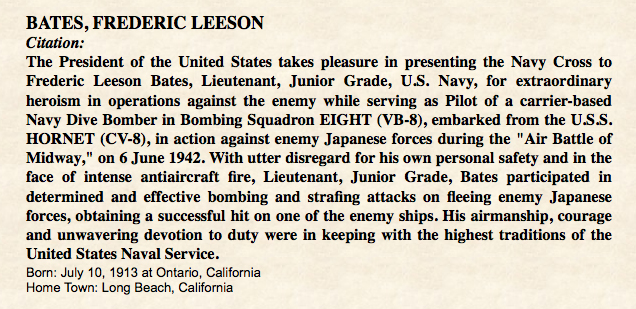
A VERY SPECIAL ARGUS C3. There are two things that make this Argus C3 special: 1) It has the Argus Sandmar wide angle 35mm f/4.5 lens rather than the normal 50mm f/3.5 lens. Some vendors are currently asking more than $300 for this lens. 2) This camera was presented to a departing Naval officer, Captain Frederic L. Bates in July of 1957. In 1942, Captain Bates, then Lieutenant Junior Grade Bates, was a Naval pilot awarded the Navy Cross for extraordinary heroism in the Battle of Midway, 6 June 1942. The Battle of Midway, occurring just a little more than six months after the Japanese attack on Pearl Harbor, resutled in a decisive defeat of the Japanese Navy, a loss of four aircraft carriers, from which it never recovered. Although the war against Japan continued for three more years, from 6 June 1942 onward victory for the allies was inevitable thanks to those who fought so bravely on that day.
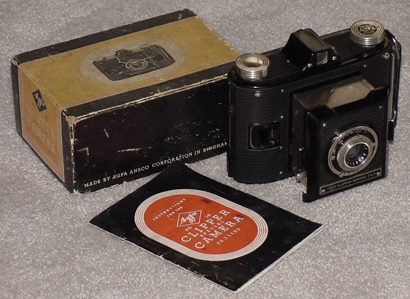
AGFA CLIPPER SPECIAL - 1939. This camera is unusual in that the lens portion slides outward in box-like fashion rather than by way of folding bellows. It was purchased on eBay in like-new condition with original box and manual for $30.
http://camera-wiki.org/wiki/Agfa_Ansco_Clipper_Special
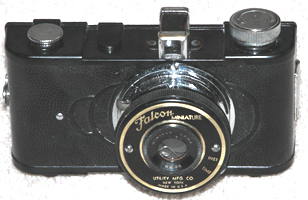
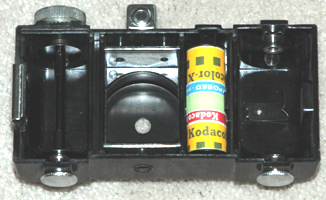
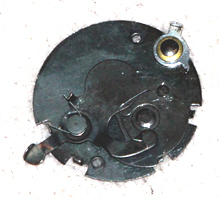
UTILITY MFR CO. FALCON MINIATURE - 1939. Typical inexpensive camera made of bakelite in the 30s and 40s. This camera and others were designed by Jack Galter and sold under many brand names. Bakelite was one of the first plastics made from synthetic components and was used for its electrical nonconductivity and heat-resistant properties in electrical insulators, radio and telephone casings, and such products as kitchenware, jewelry, pipe stems, and children's toys. The styling of the Falcon was intended to make it appear similar to the Argus A. The second photo above shows a roll of 127 film in the Falcon's storage compartment. The thrid photo shows the very simple shutter mechanism used by many inexpensive cameras of the time, including many Kodak box cameras. Lens: 50mm, fixed focus and aperture. Shutter: bulb and 1/25 second. The list price of the Falcon was $3.98 (about $66 in 2012 dollars), but normally sold for much lower prices. One Ad by Abes of NY was for $1.79 (about $30 in 2012 dollars.
http://camera-wiki.org/wiki/Falcon_Miniature
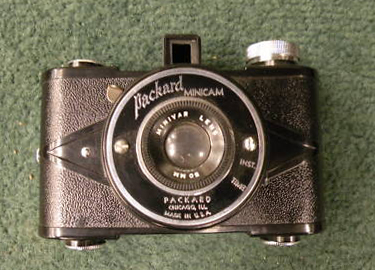
UTILITY MFR CO. PACKARD MINICAM - 1939. The
minicam was one of many inexpensive cameras manufactured by the Utility
MFR Company of NY and Chicago and is typical of the entry level
bakelite cameras common of the time. The can be purchased today in the
$10-20 range in excellent condition.
http://camera-wiki.org/wiki/The_Chicago_Cluster
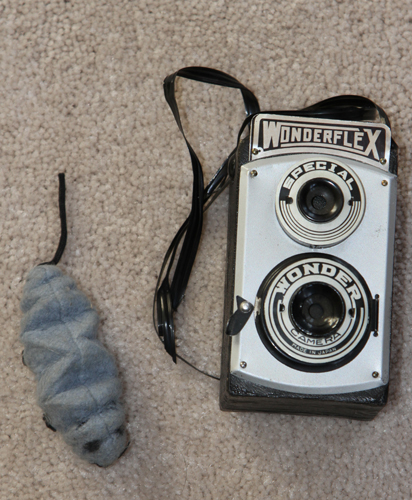
MOUSE CAMERA .
This gag camera from Japan is just one of thousands of non-camera items
that one can collect such as bracelet charms, coffee cups, hats, pins,
clocks, imitation cameras, etc. Indeed, it is possible to have a very
large photography collection without a single camera in it! Many such
items are shown in McKeown's Price Guide to Antique & Classic
Cameras and some have siginificant monetary value. The camera shown
above makes a squeeking sound as the cloth mouse with a spring inside
pops out and flies three feet or more onto the lap of the startled
victim.
McKeown's Cameras, 12th Edition (2005-2006), page 1100.
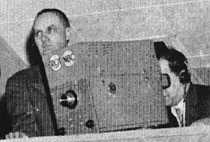
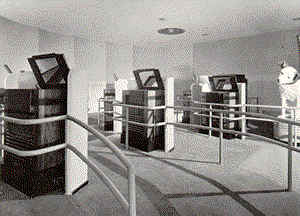
TELEVISION
AND WORLD'S FAIR - 1939. Television was broadcast
by RCA from the 1939 New York World's Fair. Visitors during the fair not
only were able to see television for the first time, they also brought home
wallet cards to prove they'd been "televised." President Franklin
D. Roosevelt, present at the creation of RCA and a frequent speaker on radio,
became the first president to be seen on television when the Fair's opening
ceremonies were telecast ten days later.
https://www.earlytelevision.org/worlds_fair.html
Additional
information concerning early television can be found at:
http://www.pharis-video.com/p2050.htm
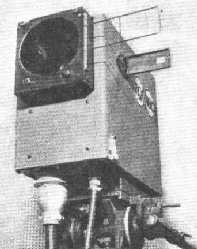
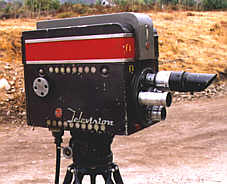
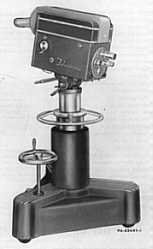
1938 RCA
Iconoscope
RCA TK-10A Television Camera
Additional
information and photos concerning early TV cameras can be found at:
http://www.pharis-video.com/p21.htm
http://www.pharis-video.com/p2050.htm
FIRST REGULAR COMMERCIAL ELECTRONIC TV IN THE U.S. - 1939. The first regular electronic, commercial broadcasts were begun by NBC (RCA) in New York City in April 1939.
https://www.historyofinformation.com/detail.php?entryid=4684
1930s