

CANON
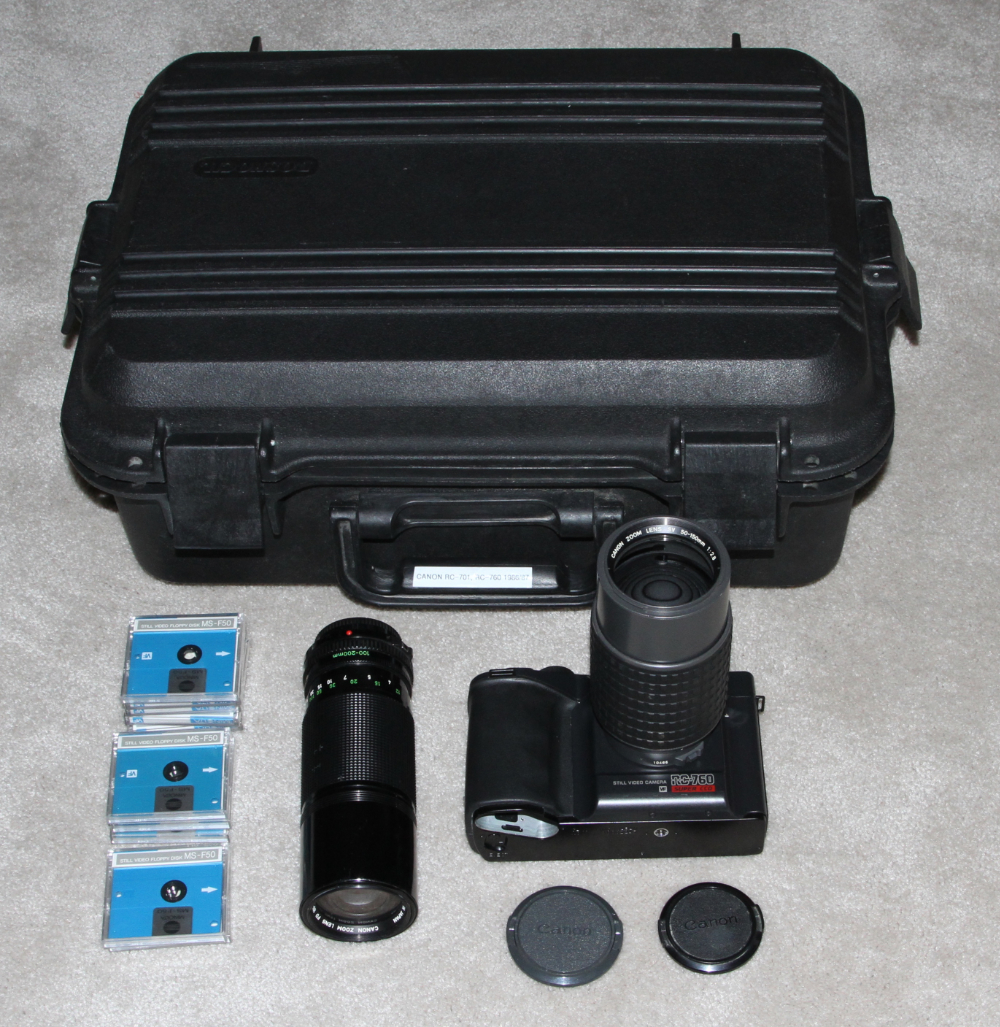
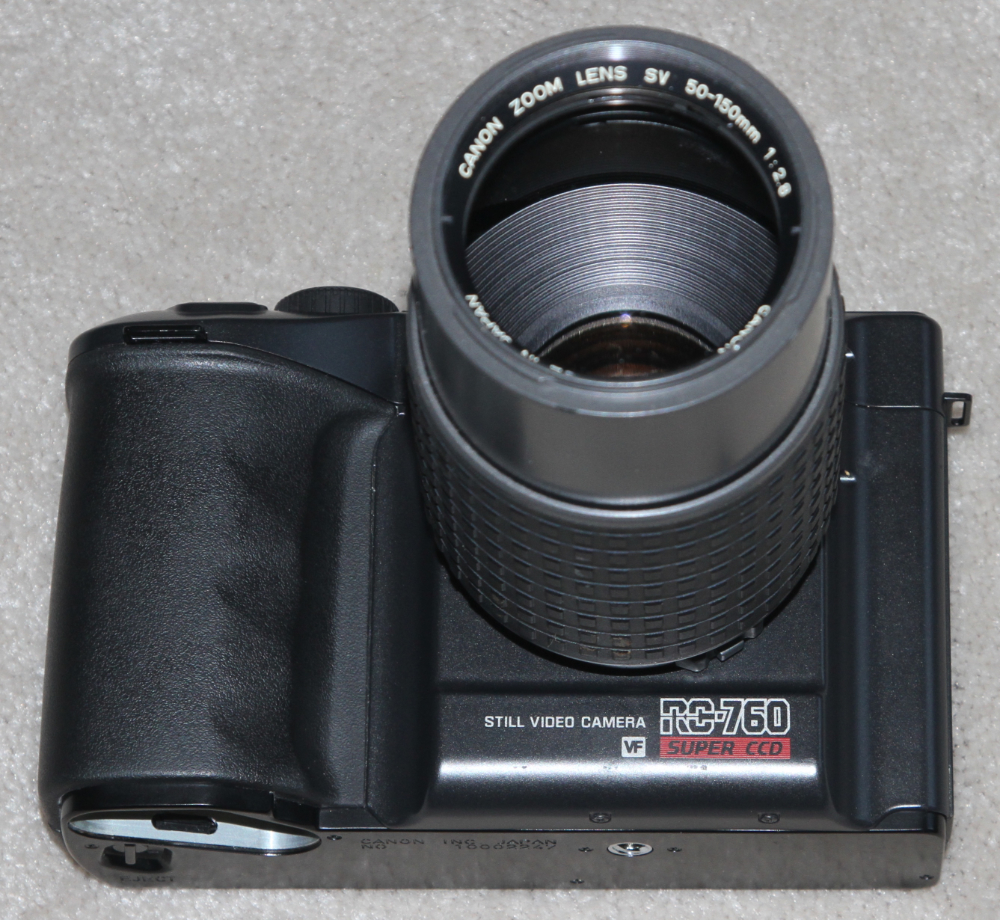
RC-760 - 1987.
Still video
camera.
600,000 pixel CCD. USA Today began covering special events with
the
Canon RC-760 camera in 1987. USA Today published the first color
still-video photos to appear on the front page of a U.S.
newspaper.
Shot with a Canon RC-701 by staff photographer Tom Dillon, the images
were
taken at a World Series game in Minneapolis. Photo editor Frank
Folwell
was impressed with the transmission speed - he was viewing the images
on
his computer in Virginia 12 minutes after they were taken. But
the
technology still had a long way to go to meet image-quality standards
even
for newspapers. The Associated Press announced plans to convert from
analog
to digital image transmission, cutting transmission times by 90
percent.
The conversion took about five years to complete, but it helped to push
newspaper photography into the digital age. The fruit photo on the
right is an example of a RC-760 image. The RC-760 is virtually the same
as the earlier RC-701, except that it has 600,000 pixels rather than
the 380,000 pixels of the RC-701. Original MSRP $5,500 ($11,300
in 2013 dollars). There were very few RC-701s and RC-760s produced, thus they
are in high demand by collectors today. Most are in museums or
held by collectors who are unwilling to part with them because of their
rarity. When they do appear on eBay the price for the body and a
single lens may be up to several thousand dollars, sometime more (2013).
http://global.canon/en/c-museum/history/story07.html
http://siecleinventionphoto.elcet.net/siecle_digital_gallery.html
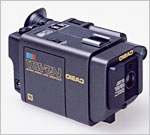

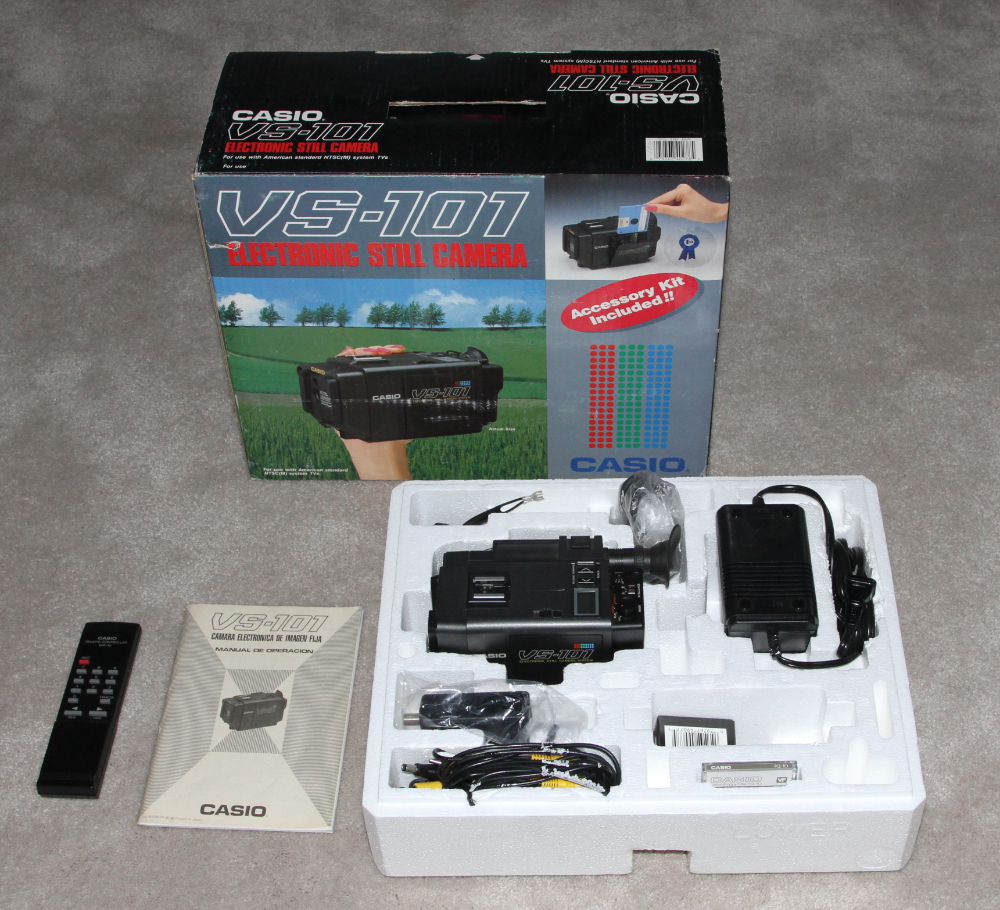
CASIO VS-101
- 1987.
First marketed MOS imager (metal oxide semiconductor) still video
camera. 280K pixel CCD. 50 erasable frames per
two-inch floppy disk (exposed at up to 5 frames per second).
Approx. $1500. We purchasde this new-in-the box VS-101 for $100 complete
with all accessories plus $20 for shipping.
http://world.casio.com/corporate/history/chapter02/
https://www.digitalkameramuseum.de/en/esvc/item/casio-vs101
ELECTRONIC IMAGING PHOTO BOOTHS - 1987 .
ImageWare Systems, Inc. maufactured and operated photo booths from
1987-1994 which allowed customers to have their photos placed onto
postcards. The company sold one of its patents to Atlus, a Japanese
company that was involved with the production of Print Club photo
booths (see 1995).
ImageWare%20Systems%2C%20Inc.%20%2B%20%22photo%20booths%22&f=false
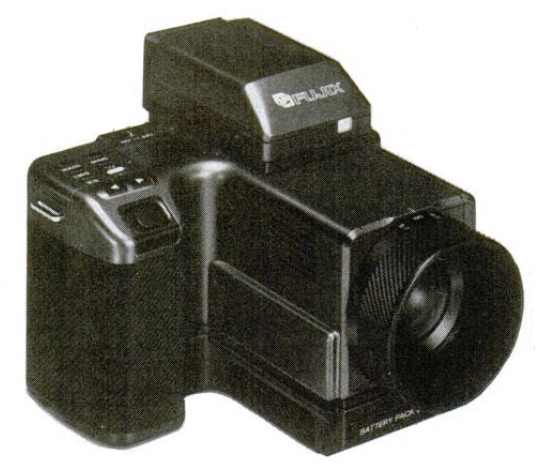
FUJIX ES-2P - 1987. Follow-up
of the 1985 still video ES-1. Popular Photography, November 1986, page
70. NOT MARKETED.
https://books.google.com/books?id=Y-QDAAAAMBAJ&pg=PA16&lpg=PA16&dq=Fuji+%2B+%22es-2p%22&source=
https://www.digitalkameramuseum.de/en/esvc/item/fujix-es2p
James McGarvey
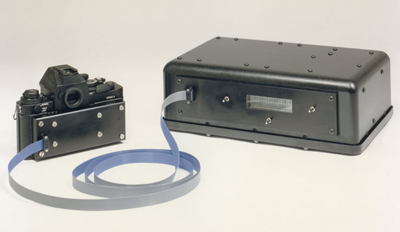
KODAK ELECTRO-OPTIC DIGITAL CAMERA - 1987. The first DSLR (digital single lens reflex camera). The Kodak Electro-Optic Camera was designed and constructed by Eastman Kodak under a U.S. Government contract and was built around Kodak's 1986 1.4 MP CCD. It was designed to appear as a normal 35 mm camera and had a ribbon cable concealed in the camera strap connecting the camera to recording equipment in the camera bag. The CCD was built into the camera back by replacing the film pressure plate in a Canon F-1 35 mm camera. Analog video went through the ribbon cable to the analog/digital converter in the camera bag or back pack. Data was stored on a 100 MB hard drive. Image size was 1340 x 1037 pixels, or 1.39 MP. Images were downloaded to a dock designed for that purpose which stored the digital images on 8 mm video tape using an Exabyte tape drive. To view the images it was necessary to use a computer that also had an Exabyte tape drive. The Electro-Optic Camera was designed by Kodak's James McGarvey, lead engineer in Kodak's Federal Systems Division who kindly supplied the above photo and information. Kodak engineer Bill Toohey designed the analog circuitry and technician Tom McCarthy assembled the system. NOT MARKETED.
Much
more information concerning this and other early Kodak DSLRs can be
seen on Mr. McGarvey's web site at http://jemcgarvey.com
KODAK STILL VIDEO SYSTEM - 1987. Kodak entered the still video market with products for recording, storing, manipulating, transmitting and printing electronic still video images. Understanding Electronic Photography, John J. Larish, 1990, p 31.
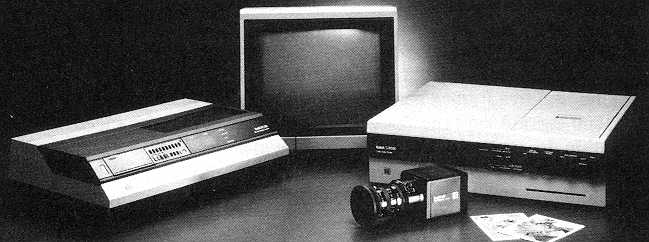
Kodak
Still Video System with Multidisk Recorder, CCD Camera and Printer
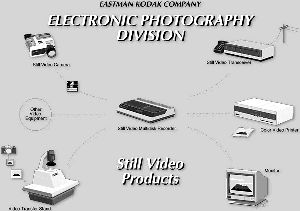
Kodak
Still Video System of 1987
Click on
image for enlarged view
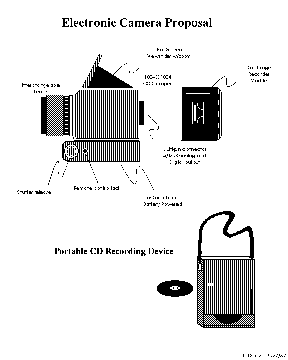
Proposed
Kodak electronic camera using digital audiotape image recording or
portable CD image recording. Camera designed in 1987 by Pete J.
Sucy, a Kodak photo illustrator and filmmaker
, but not approved (unfortunately) for production by Kodak
management. The camera would have stored raw image data and the
host computer software would do the conversion to the appropriate file
format for the host computer. The intent was to have an ADC
(analog to digital converter) within the camera and the camera would
store only digital data. Design included interchangeable lenses
and a portable CD burner - an idea that Sony utilized thirteen years
later with the 2000 Mavica MVC-CD1000 which stored images on mini
CDs. Steve Sasson, also a Kodak engineer, had previoulsy built the
world's first known still image digital camera (see 1975), however,
Kodak managment failed to follow up on these two internal opportunities
to establish leadership in in the developing field of electronic
photography. Click on image for enlarged view. Information and drawings
provided by Pete Sucy. NOT MARKETED.
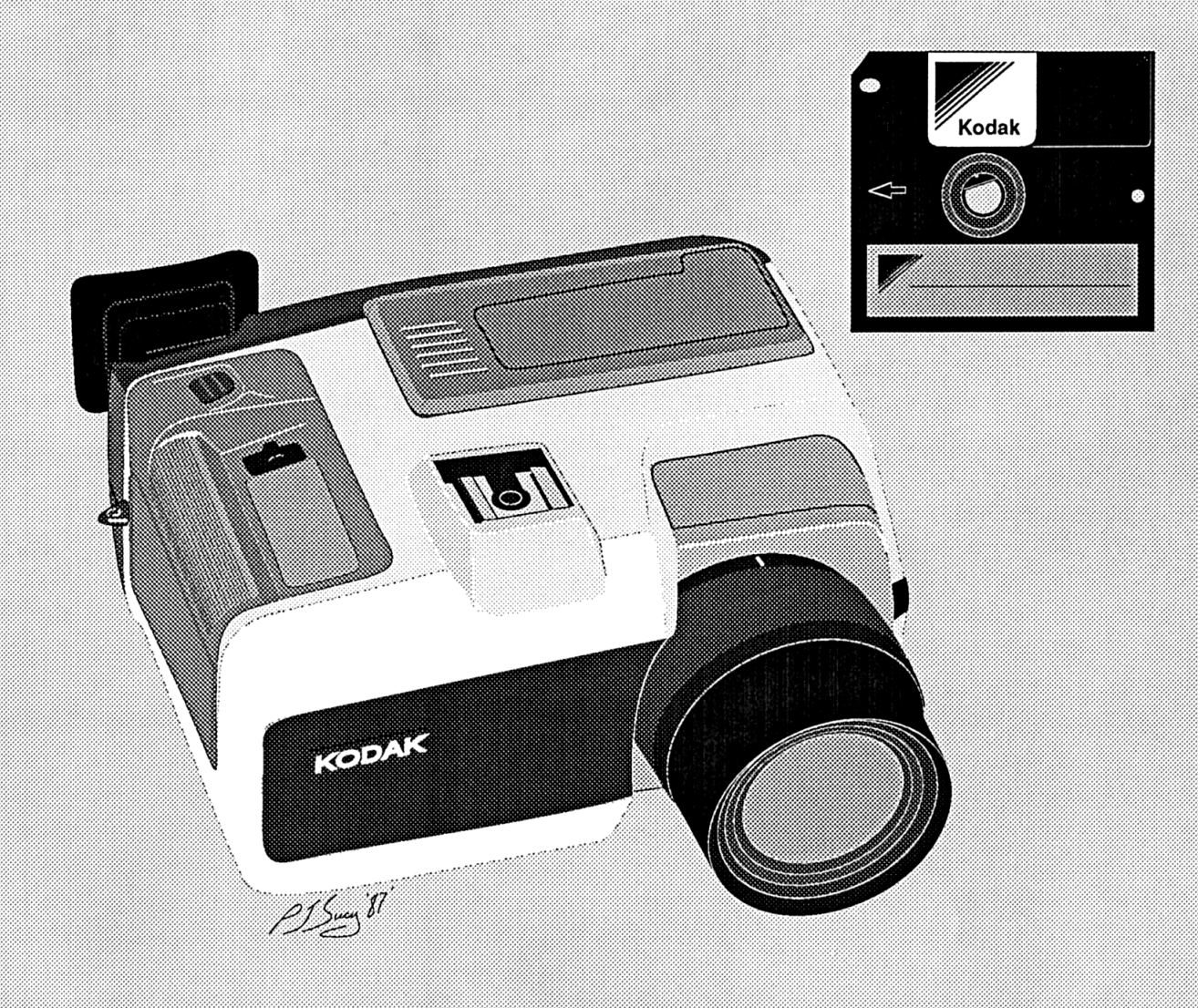
KODAK PROTOTYPES - 1987. They recorded 25 full frame images or 50 field images on a still video floppy. The cameras along with other equipment were denoted as the SV-8200 and SV-8300 by Kodak. The cameras along with associated equipment could store analog still video images and print them in color. The entire system is shown above Pete Sucy's proposed camera. Image provided by Pete Sucy. Note: Pete has a very detailed year-by-year history of the early years of digital photographhy development on his site - well worth reading! NOT MARKETED.
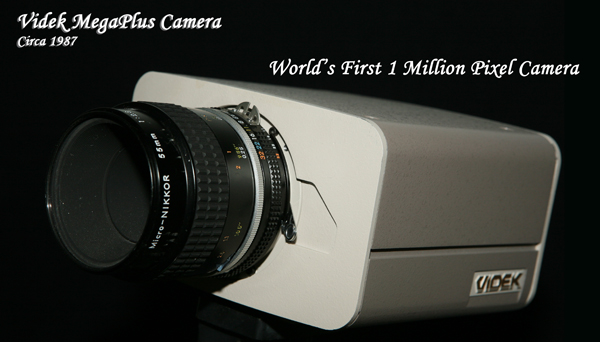
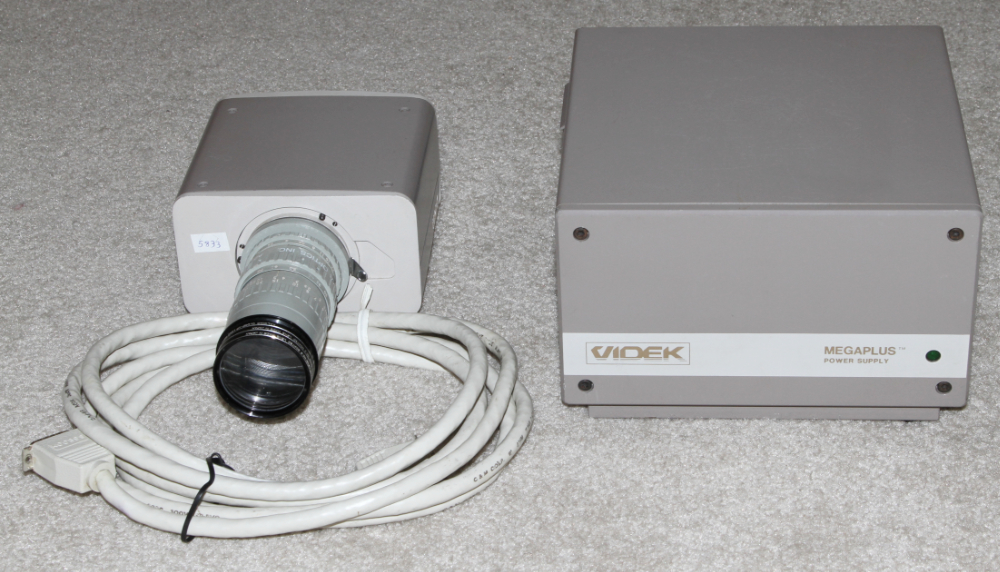
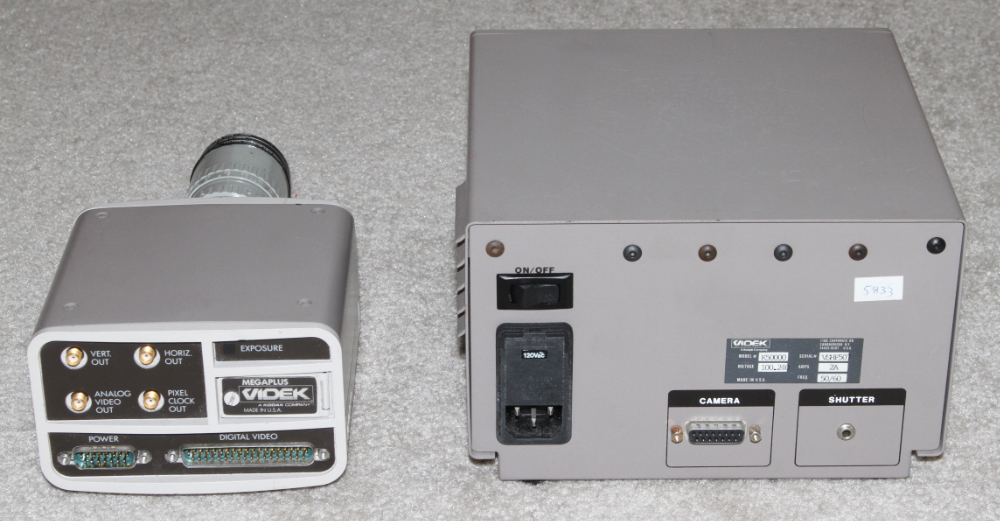
KODAK / VIDEK MEGAPLUS - 1987.
In 1986 Kodak announced the development of the world's first megapixel
digital sensor small enough to function in a handheld camera, a sensor
that had 1.4 million pixels. In 1987 Videk, a Kodak venture company,
began selling the Megaplus machine vision camera incorporating Kodak's
1.4-megapixel sensor. The MEGAPLUS was a high-resolution, charge
coupled device (CCD) camera designed for scientific and industrial
imaging applications. The camera featured a solid-state full-frame
imager containing 1320 H x 1335 V light-sensitive pixels. MSRP varied
from $10,000 to $40,000, depending on sensor quality. Some web sites
state that the Megaplus was the world's first commercial digital
camera, however,
it required an external signal processing unit (28 pounds - photos on the right) and a
computer to produce and store digital images. Videk is now a privately
held company. Photo on upper left kindly provided by Jim Reda, Videk VP. (Rare on U.S. eBay)
https://commons.wikimedia.org/wiki/File:Kodak_Videk_img_0832.jpg
https://www.digitalkameramuseum.de/en/cameras/item/videk-megaplus
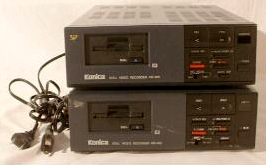
Konica KC-400 Still Video Camera and KR-400 Still Video Player
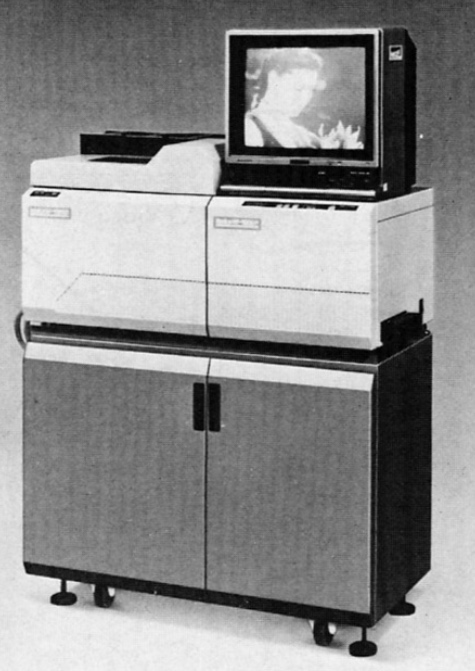
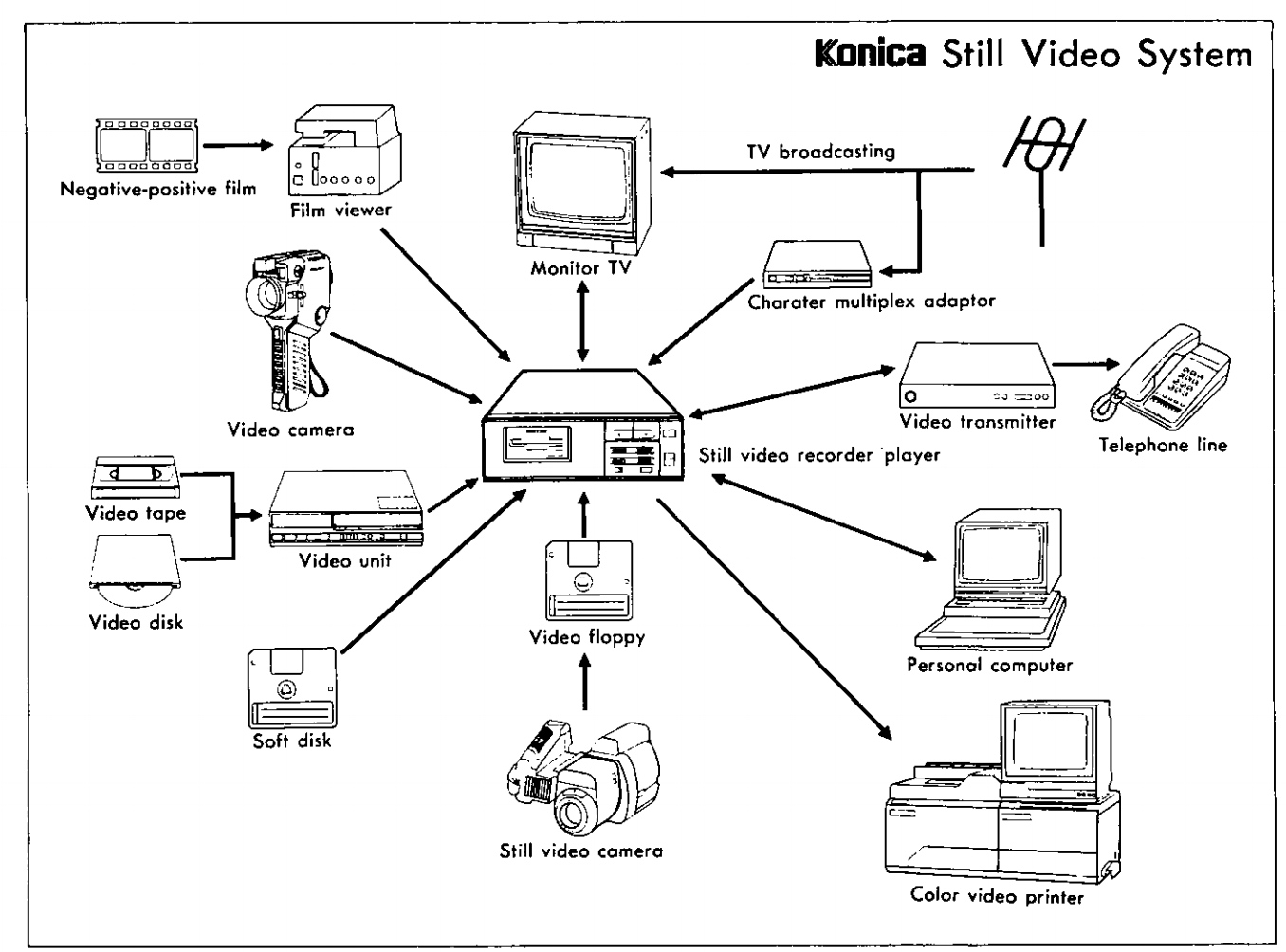
Konica VP-1000 Still Video Printer and Still Video System
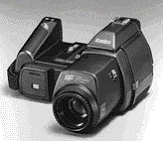
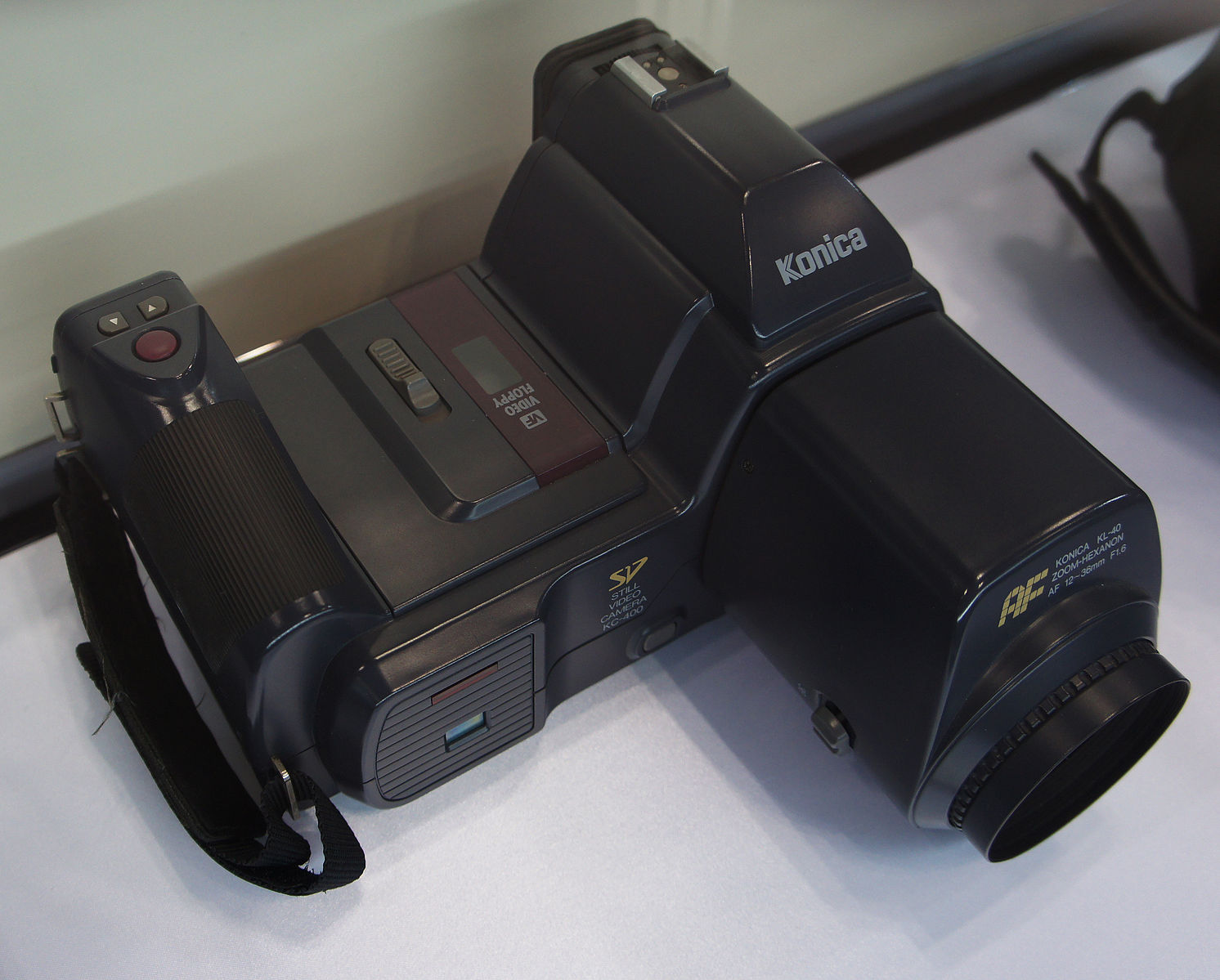
KONICA KC-400
1987. Still
video camera. Recorded to floppy disk. 1/2-inch 300K CCD.
MSRP $3,879 (approximately $7,200 in 2009 dollars). It used the
Konica KR-400 to play images. Understanding Electronic Photography.
John J. Larish, 1990, p36.
https://www.konicaminolta.jp/about/research/technology_report/1988/pdf/8.pdf
https://www.digitalkameramuseum.de/en/esvc/item/konica-kc-400-1987
https://commons.wikimedia.org/wiki/File:Konica_KC-400_CP%2B_2011.jpg
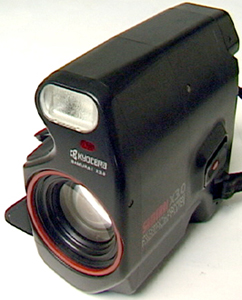
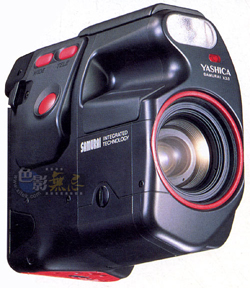
KYOCERA SAMURAI X3.0 - 1987 (YASHICA - 1988). Despite appearances, these cameras were neither video cameras nor movies cameras, but Instead were the first models of a series of ergonomic (built-to-fit-the-hand for one-hand operation), half-frame, film SLRs that Yashica/Kyocera manufactured beginning in 1987. This video camera format was used again in 1990 with the Yashica Samurai V-70 still video camera and in 1998 with the Yashica Samurai DG1300 digital still camera. Kyocera zoom lens: 25mm-75mm,1:3.5-4.3 in half-frame, effective f-stops from f3.5 at wide angle to f4.3 at telephoto. Shutter: 2 sec. to 1/500 sec. The standard model is black, but the control buttons came in different colors, such as red and green.
http://corsopolaris.net/supercameras/half/halformat5s.html
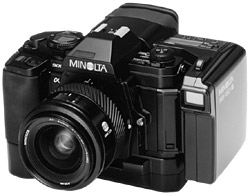
MINOLTA
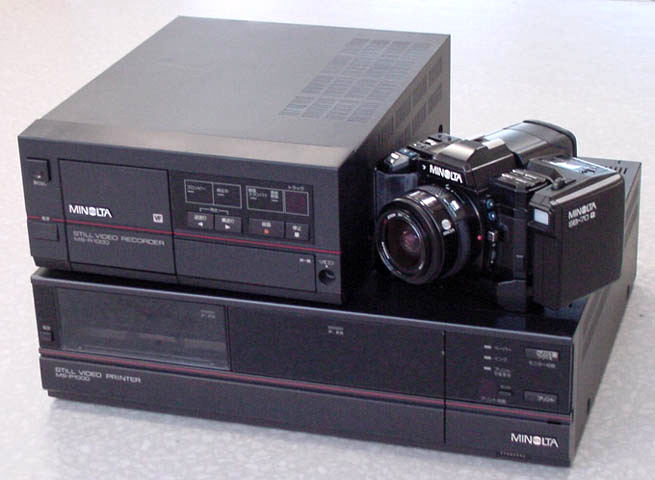
SB-70/S and SB-90/S - Maxxum 7000/9000- 1987.
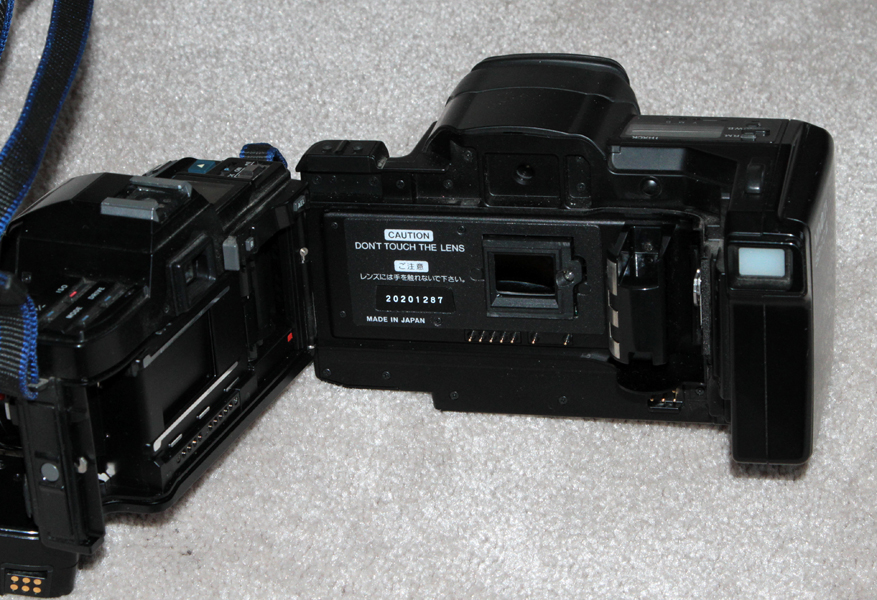
A still video camera system was devised by developing Interchangeable
still video backs for the Minolta Maxxum 7000 and 9000 35mm film
cameras. The cameras used the A-bayonet of the Minolta AF
objectives as well as the system accessories usual for the cameras of
the AF series. The standard lens was 20mm and the back had
a 2/3-inch 640 x 480 pixel CCD. The photo in the
middle
shows the still video back opened away from the Maxxum 7000 camera on
the left. The photo on the right shows the MS-R1000/S recorder (top)
and the MS-P1000/S printer (bottom). The backs were available
with or without the S-designation
which was used to indicate either the Japanese market or the
U.S. market (S). MSRP for the back alone was $2,900 (about $5,700 in
2011
dollars). Understanding
Electronic Photography,
John J. Larish, 1990, p37. This is one of only two other Minolta cameras with digital
back that we have ever seen on eBay.
One sold on eBay in 2011 for $1,125, and one on eBay in March of 2018
asking $1,799. See the following web sites for a lengthy
discussion of these still video backs. (Very Rare on U.S. eBay)
http://www.mhohner.de/sony-minolta/onebody/sb-90
http://www.9000.org/index.php?page=backs
P60U
LU-500 Screen
LU-500 Box
LU-500
Box Contents
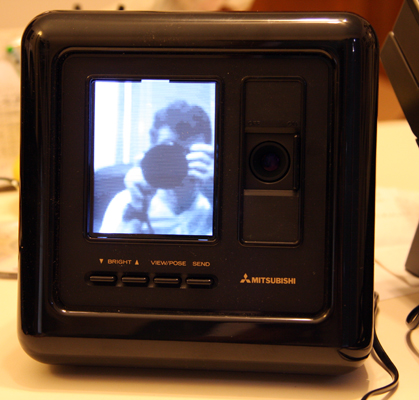
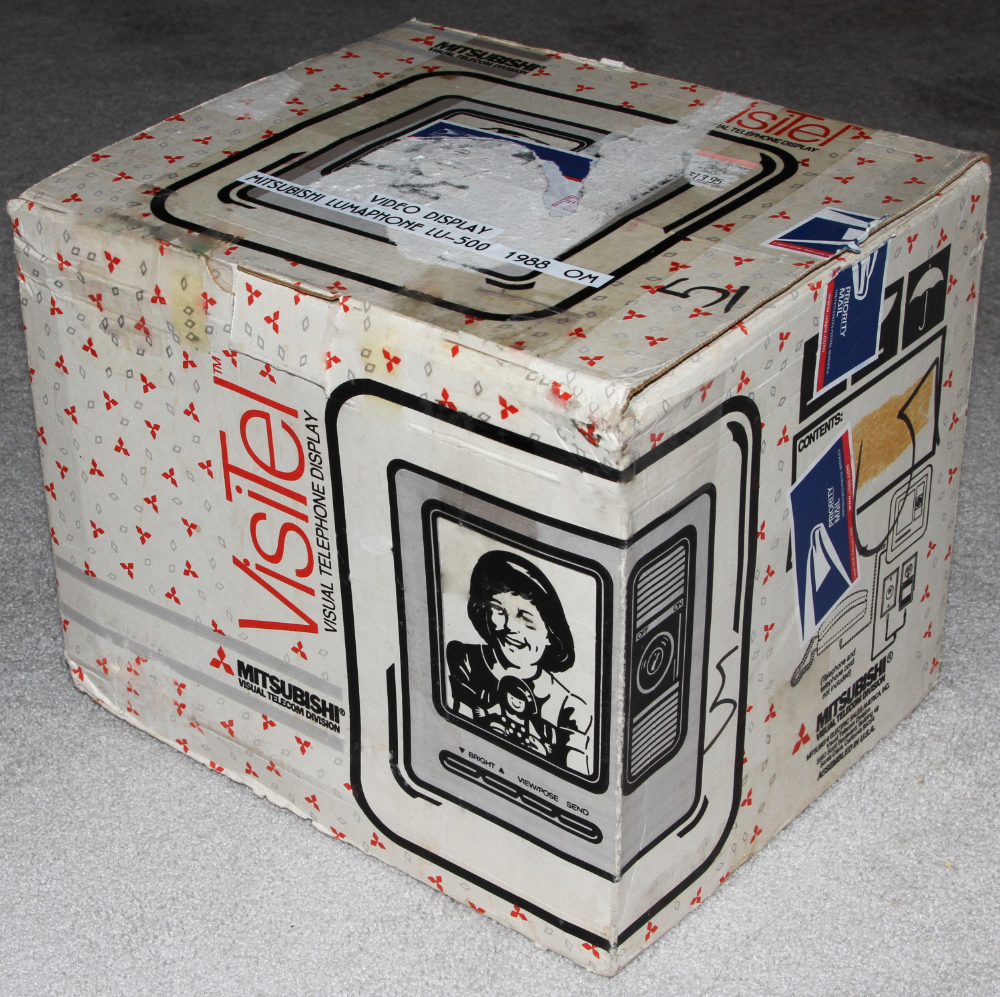
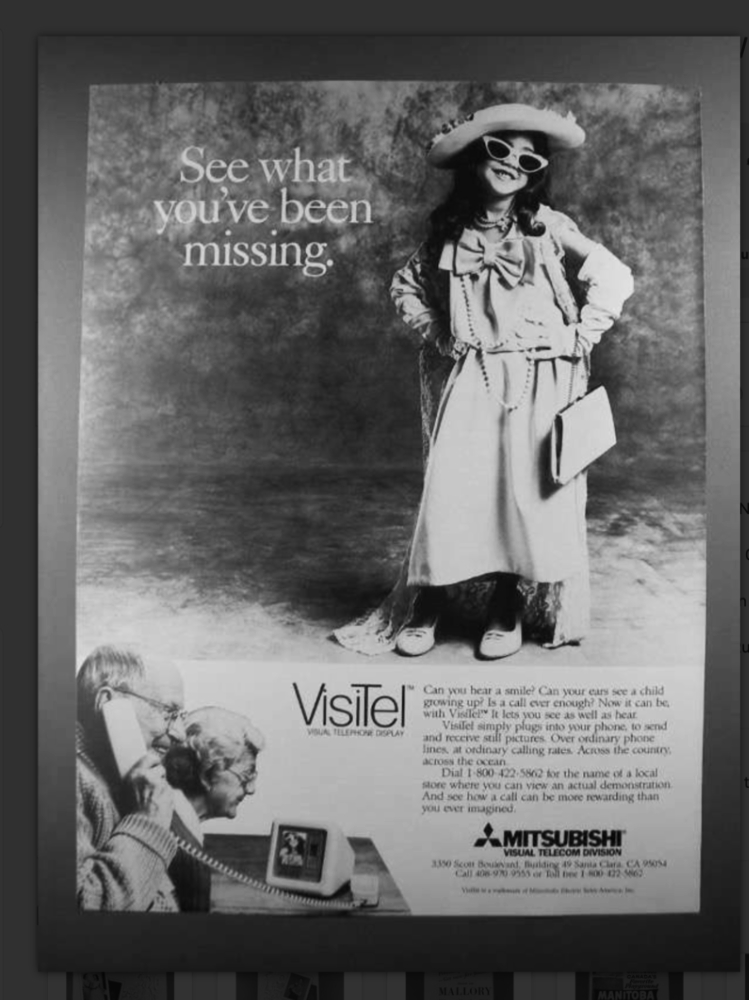
MITSUBISHI VISITEL LU-500 PICTURE PHONE - 1987. The
Lumaphone began as a division of the Atari Video Game Company. The
division was called Ataritel. Atari Sold the division to Mitsubishi in 1984. The "Lumaphone",
the Atari Videophone in its finished form, was advertised in 1985 and
sold by Mitsubishi Electric of America in 1986 as the Luma LU-1000 (See 1985). The
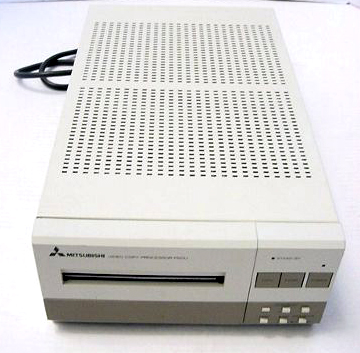
Lumaphone could transmit an image in 3-5 seconds and could have a
parallel printer attached for printing out small black and white images
(Mitsubishi P60U). Also, a TV could be hooked up to the unit for
conference room meetings.
This Lumaphone, VisiTel LU-500 (in new condition) and information were kindly
provided by Mike Mozart of JeepersMedia. MSRP $400.
https://www.youtube.com/watch?v=cBFeH2YawV4 L-500
https://www.youtube.com/watch?v=oJgBhesWdfg
http://www.youtube.com/user/JeepersMedia
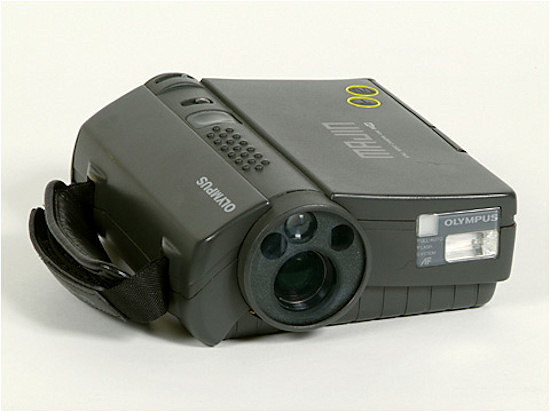
OLYMPUS V-100 MAJIN - 1987. The V-100 still video camera was part of a modular system which included a V-200 or V-300 playback processor. The V-100 used a 1/4-inch, 360K-pixel CCD with a 9-27mm f/2.8 zoom lens. ISO 100. Shutter 1/8 to 1/2000 second. Built-in flash. Hi-band still video mode. Burst mode of 5, 10, 15 photos per second. Understanding Electronic Photography, John J. Larish, 1990, p39. First photo is with playback device attached. Playback device could produce some darkroom effects. Popular Photography , December 1988, page 94. NOT MARKETED.
https://www.pressreader.com/australia/australian-camera/20190901/282114933211630
http://camera-wiki.org/wiki/Olympus_VC-100
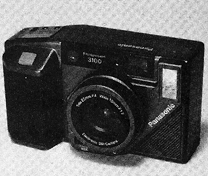
PANASONIC PHOTOVISION 3100 - 1987. Still video camera. The 3100 recorded 300K images onto a mini floppy disk. Predecessor of the 1988 AG-ES10. MSRP $1,200. Technical Photography, January 1987, page 42. Photo provided by Mike Mozart of JeepersMedia. NOT MARKETED.
http://www.youtube.com/user/JeepersMedia
https://www.digitalkameramuseum.de/en/esvc/item/panasonic-photovision-3100
https://fotossztorik.blog.hu/2019/07/01/5_fotos_kutyu_a_nyolcvanas_evekbol
1987